
Crimson Cabaret - Prologue (Part 2)
William "Bill" Elliott - Tucson - 1892

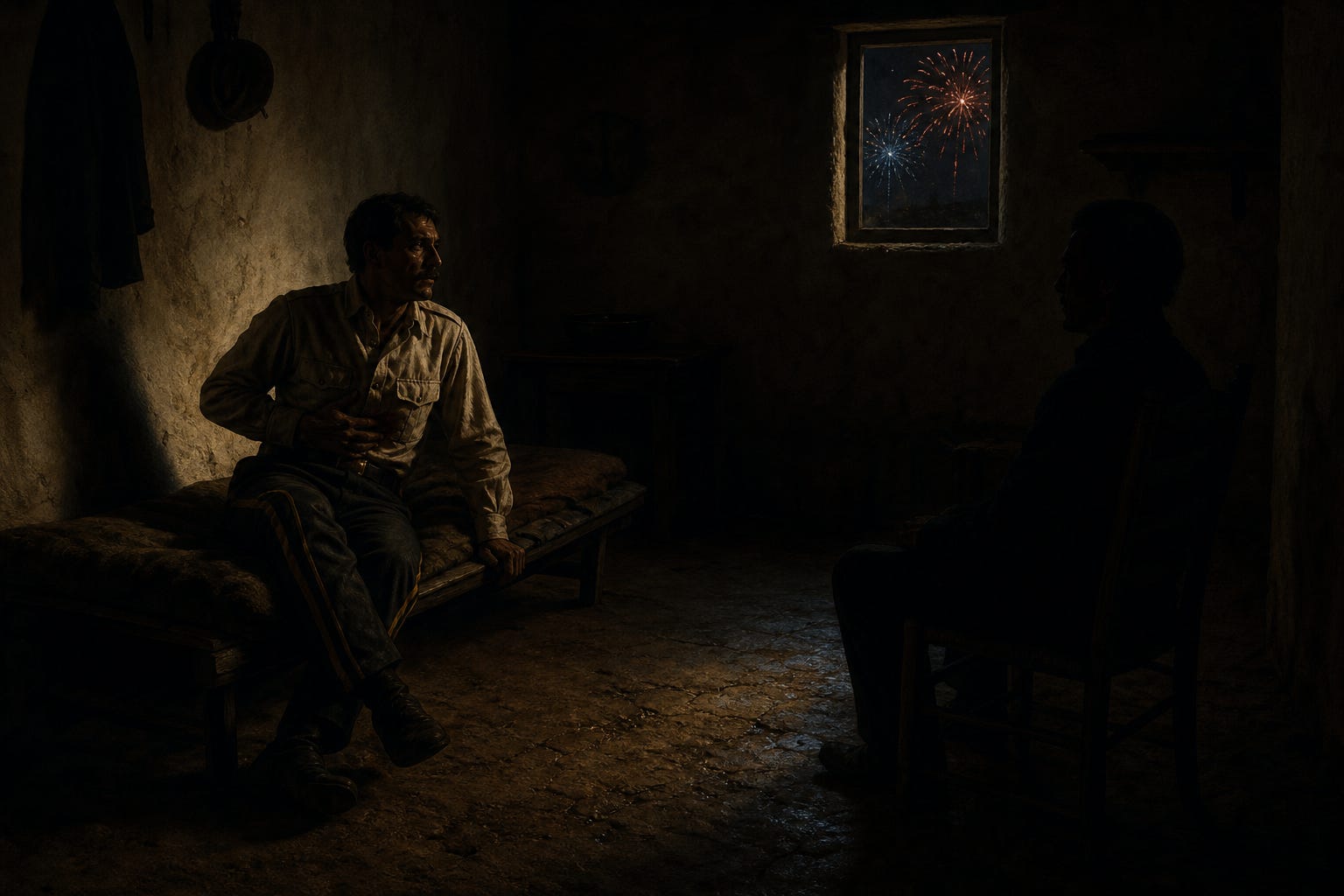
He came back into himself the way he had once come back from a river he should not have crossed in March. By inches. The cold of the bottom letting go of his boots first and then his knees and then his belt, and his belt last, because his belt had been the thing the river had wanted.
The room was dark.
That was the first thing he had. The room was dark and the dark had a shape to it. Walls close enough that he could feel where they were without seeing them. Air that did not move. A ceiling he was not yet sure about.
He lay on his back on something hard with a folded thing under his head. Not a pillow. A coat, maybe. The fabric had buttons against the side of his face, two of them, brass by the way they pressed.
He listened.
There was a city outside. Not a near city. A city held off by a wall. A pop somewhere far off, and then another, and then three together, and a long roll of something that was not weather. He knew the sound. A porch, this date last year, the same sound rising off the river to the south of town. Fireworks. Independence Day.
That meant it was July fourth. That meant he had lost a day.
He did not move yet. He could not say why he did not move yet. The not-moving had a quality to it that he did not understand. He was waiting for the bottom of him to catch up to the top. He was waiting for the part that hurt to start hurting.
The part that hurt was not hurting.
He set his palm flat against the cloth at his side. Where Reyes had put the knife. He had felt it go in twice, once on the way in and once on the way out, and the second pass had been worse because the second pass had told him it was not done. He remembered putting his hand to the place after. The wet of it on his fingers. The sound he had made, which had not been a word.
Under his palm now there was cloth. There was a stiffness in the cloth that he understood, because he had seen blood dry on cloth in the four years he had worn the uniform. The cloth told him something had happened. The cloth told him his memory of the knife was not a thing he had imagined.
His fingers walked up under the cloth.
There was a place there. A pucker. A tightness in the skin like a knot that had set wrong. It did not hurt. It did not throb. It did not warm under his hand. It sat in him like a stone that had been there since boyhood, like a place he had healed from years ago and stopped thinking about.
He took his hand away.
His hand was not shaking.
He thought about that and could not understand it.
I should be shaking.
The thought arrived in his head clean and clear and not in the voice of a man who was shaking.
He sat up.
He did it the way a man sits up. He did not feel any of what a man should feel doing it. There was no push from the abdomen, no tightness in the small of the back, no breath drawn for the work of moving. He simply was lying down and then he simply was sitting, and the change had no cost in it that he could find.
His feet were on a floor of packed dirt. He knew the floor by the cool of it through his socks and by the smell that came up from it when his weight pressed. Earth that had been swept and watered and swept again, year on year, until it was harder than wood and softer than stone. The smell was old. Old wood somewhere, and the dry chalk smell of the white earth they used here for plaster, the kind you tasted in the back of your throat in a room that had been closed up.
A room off a courtyard, then. He knew the shape of that kind of house. Plenty on his beat looked the same from the inside. The house would have its rooms set around an open square in the middle, doors opening onto the square, not onto the street. A house turned in on itself. A house that did not give the street anything.
The walls held heat. He could feel that without touching them. A daytime heat that the adobe had drunk and was now letting back out, slow as a man bleeding patient. It would be like that until two in the morning.
There was no lamp at the wall in front of him. He could feel the wall there, and he could feel where the small high window would be if there were one, and the window was dark in the way a window is dark when nobody has lit a lamp behind it for the street.
He understood, slowly, that he was not in his own boarding room.
A man was in the chair across from him.
The man had been there the whole time. Bill knew this without being told. The man had been there before Bill had come back into himself, and the man had been there while Bill had set his palm against his own side and found the place that had no business being where it was, and the man had not moved while any of that had happened. The man was not moving now. The sitting had gone on long enough that it was no longer a posture.
Where is she.
That was the first thing his head put together. Before the room. Before the man. Before the missing day. Where is she.
“Where is she,” he said.
His voice came out of him strange. There was no rasp in it, no dryness, no scrape of the dust he had been breathing on Meyer when the cut had taken him down. The words came clean. They came clean in a way his words had never come clean. He heard them leave him and he did not know the throat they had come from.
The man did not answer at once.
He looked at Bill the way a man looks at something he has already decided about. Not unkindly. Not warmly. With the kind of attention a craftsman gave to a finished piece, checking it for the things that needed checking. He was an older man, fifty maybe, hair gone to silver and worn shorter than was fashion, his face shaved bare. Plain dark trousers. A linen shirt that had been washed enough times to lose its newness without losing its keeping. His hands rested on his knees. They did not move. Bill’s eye, drawn to find something to land on, kept landing on those hands.
“Who,” the man said.
It was not a question like any Bill had heard before. The man had not put any push behind it. The word sat between them where he had set it down. A coin on a counter. There it was. Pick it up or don’t.
Bill’s mouth was working before his head was.
“There was a woman,” he said.
The man held his eyes.
“I saved you,” the man said. “There was no woman.”
The room was very quiet.
The fireworks went off again, far enough that they were nothing now, only a pressure in the wall.
Bill sat with the words. The same sitting from three years back, with the wire on the kitchen table, the boy from the Western Union office still standing in the doorway because he had nowhere else to be. The words had been a fact in the room and Bill had been a fact in the room and the two facts had been doing their own work on each other, and the boy had finally stepped out and closed the door, and Bill had still been sitting with it an hour later with the wire in his hand.
He sat with it now.
He had felt her hands.
He held that. He held it and looked at the man and held it some more and looked for the place inside himself where the holding would push back against what the man had just said.
The place was not there.
He had felt her hands. He had felt them at his collar, on the side of his throat, on his face. Her voice had been there too, saying something. A word not finished, or a word he had missed the end of, because the end of him had come faster than the end of the word. He could almost find the shape of it. He could almost.
He could not find her face.
She had been as real as the aching in his side an hour ago, and the aching in his side was gone now too. He set his hand to his side again under the cloth. The pucker was still there. It was still warmer than the room because his palm had been on it, and only because of that. It had no temperature of its own.
He looked at the man.
The man had not moved. Not the hands on the knees, not the line of the shoulders, not the eye. He was sitting in the room he was sitting in. He was telling Bill the thing he was telling him.
I was dying. I do not remember being moved. I do not remember being here.
An hour ago, by his reckoning, he had been on his back on Meyer with his blood going into the dirt and Cecilia over him doing something that mattered. Now he was here, and the day had moved past him without his consent, and his body was not a body he had lived in before, and the only person in the room with him was a stranger who said there had been no woman.
A man could choose. He could choose if Cecilia had been there, or choose to believe the man sitting with him. He could not choose both.
Nothing in him stood against the man.
He was a TPD officer who had been dying on Meyer Avenue and who was now sitting up in a stranger’s house on a folded coat for a pillow with his wound healed wrong and the city audible through the wall. No light to read by. No clock. No badge. No pistol. A memory that did not quite stand up.
She had hands.
He could not say it out loud. He could feel the thing he could not say sitting under his tongue. The unfinished word she had said was sitting somewhere under his hearing, in the same place. He swallowed and did not feel the swallow, and that was wrong too, and he closed his mouth around the unsaid thing and let it stay.
“All right,” he said.
The words had come out of him before he meant them to. The room had needed them. The man had been waiting for something and Bill had given him a word that would let the waiting end, and as soon as he had given the word he knew that the giving had been the thing the room had been built for.
The man’s chin moved. Not a nod. A small downward tip, the kind a man gave when a ledger had balanced.
“You will be hungry,” the man said.
The Spanish came in under the English without ceremony. Tendrás hambre. Bill caught the shape of it and let it pass; he had heard enough of the language in four years on Meyer to know when a man was choosing it for the precision of it and not for the show. The man had said it in two languages because one had not been enough.
“You will be hungry,” the man said again, in only the English now, “and the hunger will not be like a hunger you have known. It will not be in your stomach. You will not have a stomach for that any longer. The hunger is in another place. We will speak about it tonight, before sunrise, because it must be spoken about before sunrise. After tonight there will be other things. Tonight there is only this.”
Bill heard him.
He heard him the way he had once heard his sergeant in his first month on the beat, and the captain at Hagerty’s funeral when the captain had said the words a captain said. He heard him because the voice in the room was the only voice in the room, and it was steady, and it had taken responsibility for what was in front of it.
He heard the we.
He could not tell yet whether the we was a kindness or a fence.
“My name is Estevan Ochoa,” the man said.
He did not extend a hand. He did not stand. He set the name down between them and let it sit there.
“Bill,” Bill said.
He meant to give the whole of it. The man’s eye told him that the whole of it was not yet wanted, was perhaps not wanted at all, and Bill let the rest of his name stay where it was.
“Bill,” Ochoa said.
“Ochoa is dead.”
“Three years, eight months, and just over a handful of days. Just like you did last night.”
Ochoa stood, then. He stood as he had been sitting, with no transitional cost in it, and Bill registered with a slow small sickness that this was how the body he was sitting in was going to move from now on, that the cost had been taken out of it somewhere on Meyer Avenue while a woman whose face he could not find had her hands at his collar.
Ochoa walked to the doorway of the room and stopped at it. He did not put his hand on the frame. He turned only his head.
“There is a courtyard,” he said. “The gate at the far end opens onto an alley. The gate does not make a sound when it opens. I want you to know this because you will want to know it before tomorrow. You will not go through the gate tonight. You will not go through it any night until I tell you that you can. Do you understand me.”
It was not a question.
“Yes.”
“Good,” Ochoa said.
He went out.
Bill sat on the bed in the dark with the heat of the wall behind him and the city audible past the wall and the place in his side that had no business being a place. He put his hand to the folded coat under where his head had been. The coat was not his. The buttons were brass. The cloth was good, better than what a TPD officer made in a year. He set the coat back where it had been.
She had hands.
He held that in himself and did not say it. He was going to spend a long time not saying it. The agreement was already the floor he was going to stand on, made without his quite agreeing to it, and the floor would hold his weight if he did not test it. He could feel where the testing would put a foot through the boards. He could feel where it would not. A man who had been a lawman for four years could feel a floor.
There was a sound at the doorway.
Ochoa was back. A tin cup in his hand and a folded cloth over his arm. He set the cup on the small table by the bed. He set the cloth beside it.
“Drink,” he said. “All of it. You will not like it. You will drink it anyway.”
Bill looked at the cup.
The cup was full of something dark.
He looked at it a long while. He looked at it until he knew what it was. The knowing came without being told, from the same place that had told him, sitting up, where he no longer was. The understanding arrived from somewhere that had not been in him an hour ago.
He picked up the cup.
The metal of it was cool against his palm in a way the room was not cool. The dark in the cup did not steam. It did not move. It was a still dark surface and it caught no light because there was no light to catch, and his hand around the metal of the cup was not shaking.
Outside, a long string of fireworks went off all at once. The whole sky was at it. Tucson was in love with itself tonight. The wall took the sound and softened it and let it through anyway, and Bill lifted the cup and drank what was in it, and Ochoa watched him without expression, with the patience of a man who had been responsible for him and was now responsible for him in a different way.
When the cup was empty Bill set it back on the table.
The taste of the dark thing was in him. It was not a taste he had a word for. It was warm in a way no liquid had ever been warm, and it was going to a place his stomach was not, and the going of it was like a lamp being lit in a room he had not known had been dark.
He was about to be made to understand many things.
The man across from him was going to do the explaining.
The man was steady, and present, and had brought him into this room, and had given him the cup, and had taken responsibility for him in a way no man had ever taken responsibility for him. The same man had told him there had been no woman. Both of those things were now going to be true at the same time, in the same room, in his own life, for as long as his life was going to go.
She had hands.
He sat with the empty cup on the table and the taste of the dark in him and the city celebrating itself beyond the wall, and he did not say the only thing he knew that was true, because the only thing he knew that was true had no place to land in this room, and the room was the room he was in.
Ochoa pulled the chair a half step closer.
“Listen to me now,” he said.
Bill listened.
© 2025 E L Frederick | Published by Veridian Studios