
Crimson Cabaret - Prologue (Pre-Release Draft)
Estevan Ochoa - Tucson 1892
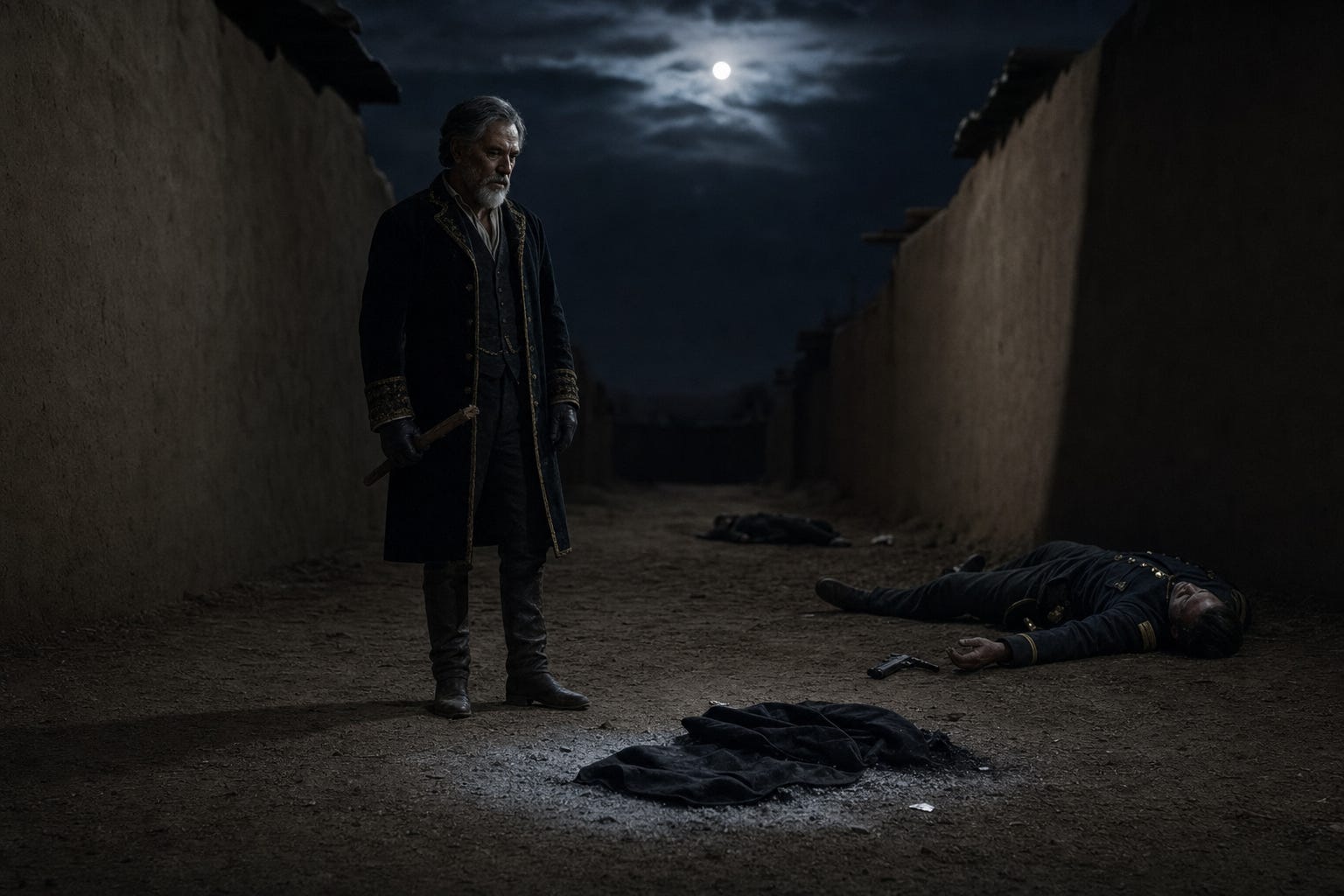
The shot came from somewhere ahead of him on Meyer, between McCormick and Cushing or close to it, and the man had walked far enough into the night to know it was a shot and not a wagon dropping its tongue. He did not run. Running was for boys and lawmen, and he had been neither for a long time now.
He kept the same pace he had been keeping. South on Meyer. Past the corner of McCormick. Past the Sosa adobe where the lamp still burned in the back window because old Tomasa did not sleep anymore and the family had stopped asking her to. The street was packed dirt that had been packed by his own boots in two different lifetimes, and he could have walked it without the moon if he had wanted to. The moon was up anyway, waxing toward full, the kind of July moon that turned the adobe walls the color of weak coffee and threw the shadows of the porches all the way out into the road.
The smell of the shot was already gone. Powder did not last in this dry air. It had a scent like a struck match and then it had no scent at all, and by the time the man reached the next cross street, his nose carried only what Meyer always carried at this hour. Horse manure dried into the dirt. The last cook fires of the evening down to coals. Somebody’s dog dead under a porch a few houses back, two days now, and nobody yet willing to be the one to pull it out.
He counted minutes. He had been counting them since the shot. A minute and a half to the corner. Two minutes more to the next. By the third corner he knew what kind of a thing it had been. A pistol, not a rifle. Indoors or just outside, judging by the muffle. Single shot. No second. Whatever had needed answering had been answered.
A shot in Barrio Viejo at midnight on a Sunday in July was a shot. It was not, on its own, his concern. Tucson had its own way of accounting for these things, and four years past he had made a decision not to insert himself into accounts that were no longer his to keep.
He kept walking anyway.
There was a particular way the air sat on Meyer Avenue when something had gone wrong. He had known it as mayor and known it again as a man no longer mayor, and he knew it now, four years dead, with the moon laying itself across the empty road. The air had that quality. Whatever had happened was still happening.
He slowed at the gap between the adobes.
The lot was a packed-dirt rectangle mid-block, set back between two windowless walls, the kind of in-between space where carts turned around and boys urinated and nothing was built because nothing had been decided. Someone had stacked a low pile of broken fencing along one wall. The slats had come down from a corral two streets over, last winter, and had been waiting since then to become firewood or to become nothing.
He saw the dead man first.
The dead man was on his side, three steps in from the corner, with one boot off and the other still on. The man had not finished falling well. There was a hole in his chest above the third button of his shirt, dark and not bleeding anymore, the cloth around it scorched and the scorch wider than the wound. The face was turned away, but the man did not need to see the face. He recognized the shape of him before he was close enough to see anything clearly. There were not many men of that build in Barrio Viejo. The name surfaced flat and without temperature. Reyes. The younger Reyes. Knife work, mostly. Once a horse, the year before he was mayor. A writ in 1876, signed in his own hand, and not a thought of the man since.
So that was the shot.
He was already past the dead man by the time he registered the rest of the corner.
The officer was on his back four feet farther in.
The block was unlit, but the moon was enough. He took it in. Brass buttons catching the white light. The dark patch under the officer’s left side where the patch did not belong. The officer breathing, shallow, but breathing, which meant whatever had cut him had not yet finished what it had started. The officer’s pistol on the dirt a foot from his open hand. One round spent. The grip pointed back toward the man it belonged to, the way pistols did when their owners had used them and let them go.
He read it in the order the evidence arrived. Reyes had cut the officer. The officer had drawn and fired. The shot was the second event, not the first.
That was when he saw the woman.
She was crouched over the officer with her back to him. The angle of her was wrong. She had her hands at the officer’s collar and her face down at the side of his throat, and she was not pressing the wound. She was not pressing anything. The posture was older than law and older than language and he knew it without needing to know who she was.
He stopped where he stood.
She had not heard him. She would have heard him if she had been listening for anything. She was not listening for anything.
He took the corner in. A vampire he did not know, on Meyer Avenue, on a public street at midnight, over a dying officer of the Tucson Police. The dead criminal. The discharged weapon. The smell of powder that was already gone. The whole composition arranged itself into a single object and he held it as he had once held a budget line item that did not balance: not with feeling, only with the certainty that it had to be resolved before the night moved.
The arithmetic was clean.
A stranger feeding on a uniformed mortal at a public crossroads was a violation that would not survive sunup. The neighborhood would speak. The department would speak. The Star would print whatever the department gave it. Whatever fragile arrangement the older men had built around this city, whatever the woman in Bisbee had built and the woman whose name he did not yet say aloud was building elsewhere, would not survive the morning.
Four years of being told what the rules were. Tonight he was the rule.
He stepped off the path of his own walk and bent toward the pile of broken fencing.
His hand went past the silver. The spike rode in the inside of his coat where it had ridden for fifteen years, since the railroad men had handed it to him in a velvet-lined box as if it were an honor and not a receipt, and his fingers brushed it on the way to the pile and kept going. He did not think about that now. He would think about it later, in the way he thought about most things, which was not very much and not for very long.
The fence slat broke clean across his knee. He chose it for the grain. The end he kept was a length of split pine about as long as his forearm, with a point on one end that the breaking gave him for free. It was not a clean point. It was a point.
He crossed the corner.
She did not turn until he was inside the last step. When she did turn, she turned only her face. Her hands stayed at the officer. Her eyes were dark and very wide and he saw in them the thing he had once seen four years ago in his own eyes, in the looking glass at the Cosmopolitan, the night he understood what he had become. There was no surprise in her face. Only the patient, attentive readiness of something interrupted in the middle of work it intended to finish.
Her mouth opened.
He drove the slat in below the breastbone and up.
He had not killed another of his kind before. He knew the rule the way men know rules they have been told but never tested. Wood through the heart held the body still. The body could be moved, questioned, disposed of. The body could not move on its own. He expected resistance. He expected the soft shock that ran through a living arm when the living arm met bone. He expected her to go rigid and to stay rigid, and he was already composing the next minute in his head, the officer first, then the woman, then Reyes, then the corner.
The slat met bone. He felt it go through.
She crumbled from the point outward. There was a sound like a cooling stove settling, and then there was no sound, and then there was no woman. What had been a woman was ash on the dirt where she had crouched, a dry gray settling that spread from the place the slat had entered and did not spread far. The coat came down on top of it. Only the coat.
The slat stayed in his hand. He did not drop it. He did not drop things.
For one breath, he stood there with the broken pine in his fist and looked at the corner where she had been, and the corner was a corner. There was a coat on the dirt that the woman had been wearing, collapsed in on itself the way a coat collapsed when nothing was left in it. There was hair on the coat. There was a pin he could not see clearly. There was ash inside the coat and ash on the dirt around it and ash on the officer’s collar where she had been crouched over him.
A stake was supposed to hold the body. The stake had not held the body.
He stood with that for another breath. The rule had come to him from a man who received it from another man, who had presumably tested it once or twice in some century he was not curious about. He carried the rule for four years as he carried the spike in his coat, an instrument he had not yet needed. The expectation had been a staked woman, rigid and manageable. The expectation had been time. Tonight the instrument was a piece of fence and the woman was ash before the motion finished, and the time he expected to have he no longer had at all.
He absorbed it as he had once absorbed a column of figures that did not match. Without complaint. Without protest. With the quiet recalibration of a man who understood that the figures were what the figures were and the page would have to be rewritten to fit them.
It cost him a second. Two, perhaps. He let it cost him that and no more.
His eyes came down from the empty corner and found the officer.
The officer was not breathing.
He registered this at the same moment he registered the rest of it. The chest had stopped its shallow rise. The dark patch under the ribs had reached its final size. The man on the dirt had finished, and had finished in the small handful of seconds it had taken to break a fence slat and cross a corner and put a point through a woman who was not where the rule said she would be.
He stood with that.
The body was a body, just as the woman’s coat was a coat. Outwardly intact. Inwardly empty in a particular way. He knew mortal corpses, and many that were not mortal, from two different lifetimes, and he knew the small shifts a face made when a man left it. The face on the dirt had made some of those shifts. It had not made all of them. There was a stillness in it that was the stillness of a thing finishing one thing and not yet beginning the next.
Four years he had been what he was. He knew, with the knowledge of a man four years and not forty into the dark, what the inside of a transition looked like from the outside. Hers had been finishing. Hers had been within a breath of complete. Whatever exchange the woman had been making with the body under her hands had been about to settle, and the wood had gone through her at the moment of settling, and what was on the dirt now was a man who had crossed a line and was lying on the far side of it without the woman meant to walk him the rest of the way.
She had not been feeding.
The thought arrived flat. He did not adorn it. He did not soften it. He stood on the lot on Meyer between McCormick and Cushing with a length of broken pine in his hand and the ash of a woman on the dirt at his feet and a man on the dirt who was not coming back tonight and not coming back as what he had been when he came back at all, and he understood what he had walked into before he had seen what was being done.
He had not stopped a violation. He had ended the only person in the world who could have explained, taught, calmed, anchored, named the thing that would open its eyes tomorrow night.
He read the corner correctly. The reading was the wrong reading.
The officer would not stir until sundown next. He knew that as he knew the moon. The first day was the long one. The body did its quiet work in the dark of itself and made nothing of itself in the meantime. By tomorrow’s last light the man on the dirt would be a different question. Tonight he was only weight.
He bent. The face was already cooling. His own warmth had left him in less than a night, four years ago, and he remembered the going-out of it and how long it took, and he could see by the slack in the man’s mouth that the going-out was underway.
He set his hand under the arm and got him up.
He looked at the corner once more before he turned.
The ash of the woman lay where it had fallen. The coat lay where it had lain. The pistol stayed where it had stayed. Reyes was where Reyes had been, which was still dead and would still be dead in the morning, when the daylight came and a beat patrolman found him and a coroner shrugged and a column went into the Star and somebody at the department asked where the officer who should have been on this beat had gone, and there would be no woman in any version of any of those questions, because the woman had been ash before any of those questions could be asked. The corner already did not contain her. The morning would not recover her. The records had never had her to begin with.
He weighed it.
A truth that could not be told in any room he could stand in, set against a man on his shoulder who could be told something else and would have nothing to set against it. A history that could be written one way, set against a history that could not be written at all. The writ on Reyes was a flat civic memory. The writ he was about to take up on this corner was something else. Three terms of a city government had taught him to balance books that could not be balanced honestly, and a sire he had not asked for had told him the night world worked the same way and that he would learn it as he went.
He was learning it now.
The lie shaped itself in him without effort. He did not draft it. He did not yet say it. He only understood, as he understood the weight of the man on his shoulder, that he would say it, and that he would say it as many times as it needed to be said, and that the first time he said it would establish every time after.
He turned with the officer against him and started north on Meyer.
The streets at this hour were the streets they were. The lamp at the Sosa adobe still burned. The dog under the porch was still under the porch. The dust on his sleeve stayed on his sleeve for half a block and then the breeze took most of it, and what was left went into the weave and stayed there and he would find it in the morning when he changed his coat, and would not say anything about it then either.
The body did not speak. The body would not speak for another full turning of the earth, and what it spoke when it spoke would already be the wrong thing, because by then there would be a different account of the corner waiting to meet it.
He kept walking.
Every step away from the lot was a small commitment. The first step was unrehearsed. The second was less so. By the time he reached Cushing he had walked the lie into his own gait, and by the time he turned east off Meyer he had walked it into his shoulders, and by the time he was past the last lit window and into the dark stretch where his own walls stood waiting for him, he was no longer carrying a body so much as carrying what the body would have to be told.
He carried both of them home.