
Rocket - Chapter 13
Rocket - Sierra Vista, Arizona

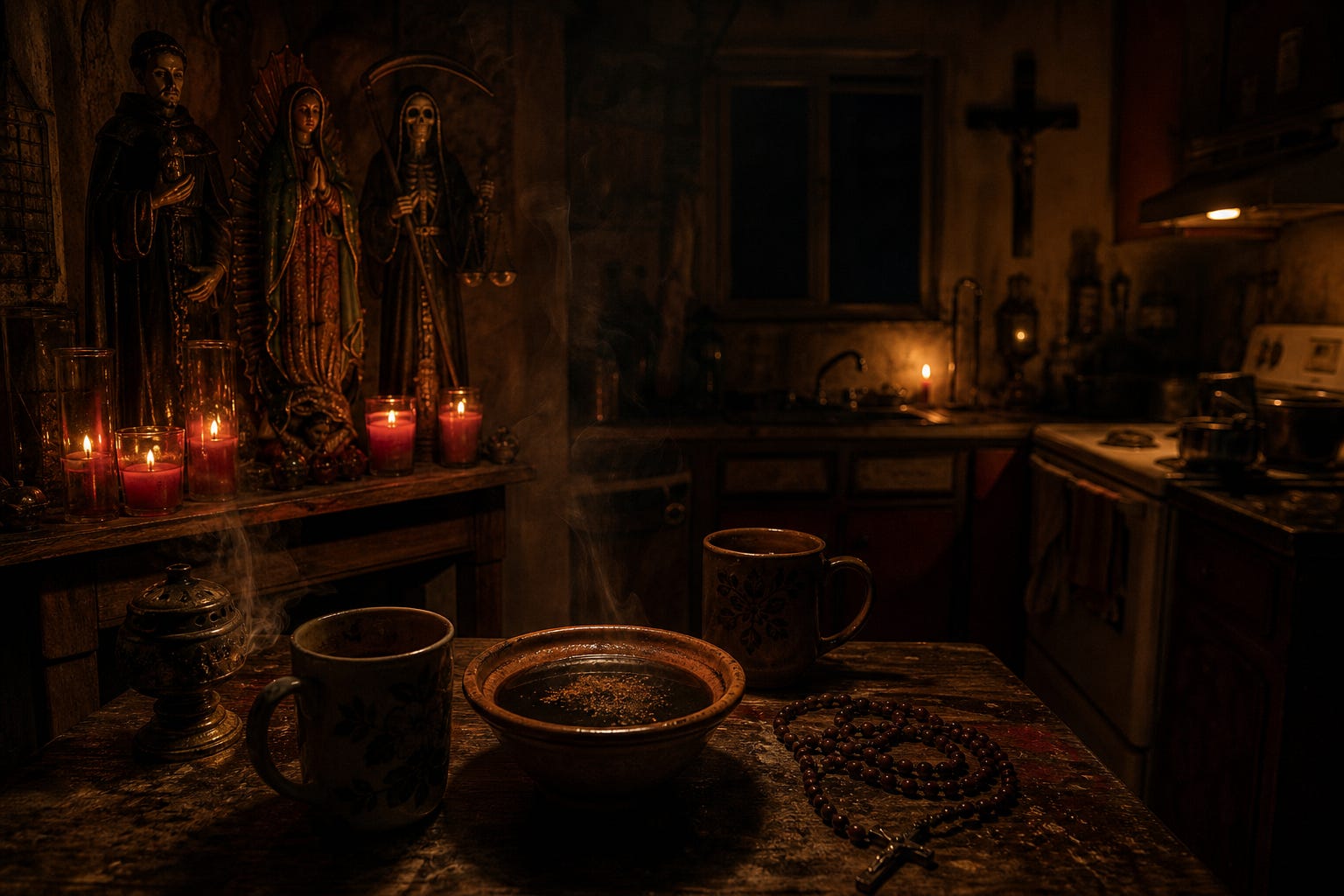
The house had looked normal from the street: southwest stucco with decorative block walls and desert landscaping that said suburban retiree rather than supernatural sanctuary. No gothic towers, no wrought iron gates, no obvious signs that something unnatural lived behind those beige walls. Just another Sierra Vista property where people minded their own business and kept their yards manageable in a climate that killed weaker plants. From the street her new senses had already been pulling the place apart, the tick of a cooling engine somewhere down the block, a sprinkler running on a timer two yards over against every water restriction the county published, the resinous green of creosote that had drunk last week’s rain and the older mineral dust of a valley that had been desert long before anyone thought to build retirement homes on it, all of it ordinary, all of it suburban, none of it preparing her for what waited on the other side of the door.
But the moment Rocket had crossed the threshold, her supernatural senses had gone haywire.
The air felt wrong: heavy, consecrated, ancient, the way a church felt ancient when you walked into one that had been collecting prayer for four hundred years. Consecrated. Like walking into a church except the sanctity didn’t come from priests or rituals or official blessings, none of the institutional paperwork that an Archbishop’s stamp could have applied to it. This was older. Earned through suffering instead of declared through authority, accumulated the way mineral deposits accumulated, the way a cave grew its own walls one slow drip at a time over a span of years no living human had been around to witness. The scent hit next: myrrh and copal incense mixing with lingering coffee and something metallic underneath that made her demon retreat with instinctive recognition, the small old certainty that whatever ran her now had been here before in some other body and had not been welcome the last time either.
Blood. Old blood. Fresh blood. Decades of blood soaked into walls and floors and the very foundation of this place.
Fuck. How many people died here? Why does it smell like church and grave had a baby?
Every wall displayed crucifixes: not the decorative kind that suburban Catholics hung for aesthetics, but the serious ones. Heavy wood, detailed corpus figures, positioned at heights that suggested they were meant for actual prayer rather than interior design. Faded portraits of saints stared down with painted eyes that tracked movement. San Martín de Porres. La Virgen de Guadalupe. Santa Muerte holding her scales and scythe like promises instead of threats.
The living room furniture had looked comfortable: overstuffed sofa, mismatched armchairs arranged for conversation. Three girls sat there, vampires all of them, their supernatural stillness marking them as predators despite their youth.
One looked about eighteen, Indigenous features with warm brown skin and long dark hair, wearing earth-toned clothing and bone jewelry. Her presence carried a solemn grace, like she was bearing weight that didn’t belong to her.
Another appeared eighteen, Mexican with deep brown eyes that seemed older than her face. Simple clothing, no pretense, quiet dignity earned through survival rather than performance.
Sisters. Maybe. If I don’t fuck this up.
The third looked around the same age: electric blue bob catching lamplight, black western shirt with pearl snaps tied at her waist, dark jeans, and brown cowboy boots that added height. She looked like she was trying to blend into Arizona border culture and failing in exactly the right ways, that electric blue hair screaming against the western aesthetic. Her sapphire eyes held something sharp and calculating that the deliberate costume couldn’t quite hide.
Abuela had led them down a hallway lined with family photographs behind glass: decades of desert life captured in graduations and quinceañeras and wedding portraits and funeral programs tucked into frames like pressed flowers. Visual evidence that this woman had been part of this community long enough to watch generations bloom and wither and return to dust.
She was at all of these. Watched them grow up. Watched them die. How does that not make you insane?
Bisbee had peeled off toward the living room. Before he did, he’d caught Rocket’s eye with that steady look she’d learned to rely on.
“You got this, kid,” he said. “I’ll be right down the hall if you need me.”
Leaving her room to make space for her own choice.
Twenty feet. He’s twenty feet away. I can hear them. They can hear me. It’s fine. I’m fine.
She wasn’t fine.
From deeper in the house, voices. Female. Young. Then sudden movement: footsteps converging, excited greetings, warmth that said family instead of performance.
“Bisbee!” The first voice carried genuine joy, no performance in it.
“I missed you.” Quieter, more tender. The kind of vulnerability that only came from safety.
Wait. She... he’s mine. He found me. I don’t... fuck, why does that make my chest tight?
“Finally! Someone interesting...” Honey-smooth accent, playful edge cutting through the moment.
“Girls.” Bisbee’s voice, that dry warning tone that conveyed affection all the same. “Give the kid some space to breathe first, yeah?”
Laughter. Easy. Comfortable. The sound of people who’d earned the right to tease each other.
The voices from the living room carried clearly enough for vampire hearing: genuine affection, questions about Bisbee, curiosity about the new girl. But Bisbee’s responses stayed low, deliberate. His responses stayed low and deliberate, protecting her story as his responsibility to keep.
He’s not telling them. Not gossiping. Keeping his mouth shut because... because that’s who he is. They don’t know yet. Don’t know about trafficking or desert or what I did. But they will. Eventually. What if they hate me when they find out?
Abuela turned those dark, ancient eyes on Rocket. “The kitchen is where we discuss important things. Where family begins. Come, mija.”
Rocket inhaled a breath she didn’t need, squaring her shoulders with false confidence that had gotten her through countless dangerous situations.
The kitchen came into view, the small bordering room every house in every Latina grandmother’s life had ever had, the room where the real conversations happened after the living room had been emptied of the men. Small wooden table beneath a window overlooking a backyard garden where desert plants grew in careful rows, agave and prickly pear and a row of small clay pots holding the herbs every curandera in northern Sonora had grown for the last hundred years. Coffee pot still warm on the counter, brewed for ghosts the same way Bisbee brewed it for ghosts, every old vampire in this part of the country apparently keeping the same private ritual against the same accumulated dead. A crucifix above the sink where someone would wash dishes while contemplating spiritual requirements, hung at exactly the height a tired woman with her hands in soapy water could glance up at without lifting her chin. Candles burning on a small shelf that held bread and flowers and carved figures, the bread already going stale because the bread was for the saints not for the household, the flowers already wilting because the flowers were the offering not the decoration, the carved figures faded with the polish of decades of fingertips.
The kitchen felt like the center of something sacred: not Catholicism exactly, but nurturing that required backbone.
But it was Abuela who commanded the space.
She moved like time itself: deliberate, unhurried, impossible to ignore. Her body belonged to a seventy-eight-year-old woman: small, slightly hunched, bones like weathered mesquite beneath loose skin. Silver hair pinned into a tight bun. Simple clothing: long dark skirt, worn cardigan, a shawl that smelled faintly of mothballs and prayer.
But her eyes.
Dark. Ancient. Holding the stillness of someone who’d counted every grain of sand between here and the border, who’d buried more people than she’d birthed, who’d survived long enough to understand that mercy and judgment weren’t opposites: they were the same thing viewed from different angles of faith, the same single object turning slowly in the same single light, named differently depending on which side of the suffering you happened to be standing on when the light caught it.
She didn’t look like someone who could reduce trained killers to ash with a glance.
She looked like someone who wouldn’t need to.
Abuela gestured to a chair. “Sit.”
Rocket sat, hyperaware of everything. Exit routes. Weapon possibilities. The way sound carried through this house: conversation in the living room too low to make out clearly now, but the tone readable. Warmth. Safety. The easy comfort that came from people who’d known each other long enough to stop performing.
That could be me. If she decides I’m worth keeping. If I can figure out how to be part of something without destroying it.
The older woman moved to the counter, poured coffee into two cups with practiced efficiency, then brought them to the table along with a small ceramic bowl that held something dark and viscous.
She set the bowl in front of Rocket. The scent hit immediately: blood. Spiced. Heated.
“If you are hungry, I have goat blood, heated and spiced with cinnamon, and a touch of honey,” Abuela offered.
Is she offering food? Testing control? Seeing if I’ll take it?
“I’ve never, I mean, can we add things to blood? Like spices?”
“Sí, mija. Blood takes spices well: cinnamon for warmth, cloves for strength, honey to soften the copper.” Abuela’s voice carried the practical wisdom of someone who’d spent decades making sustenance bearable. “Goat blood is gamey, stronger than beef or pork. The spices help mask that. Animal blood lacks the strength of human, but prepared with care, it sustains without requiring you to harm my neighbors or compromise your conscience.”
She gestured to the bowl.
“You do not have to drink now if you are not ready. But know that you will learn to feed without killing. To take from those who can afford to give. To manage your hunger instead of being ruled by it.”
Rocket nodded slowly, processing. The idea of feeding without killing, of spices making blood bearable: it was so far from her week of desperate survival it felt almost alien.
“You’ve been feeding on humans,” Abuela said as she settled into her chair. A statement, not a question. “Living blood. Fresh kills.”
Fuck. She knows. Of course she knows. Bisbee told her everything. The contractors. Robert. All of it.
Rocket’s shoulders tensed, but she made herself look up, meeting those ancient eyes. “I didn’t have a choice. I was starving. I didn’t know...”
“Peace, mija.” Abuela raised one weathered hand. “I know you are new to this. I’ve had many newborn vampires in this house. I was once new too. I understand. I’m not judging. I’m witnessing. There’s a difference.” She folded her hands on the table, patient and immovable as stone. “Now. Before we go further, before you enter this house as anything more than guest, there are things we must discuss. Questions I must ask. This is how we determine if sanctuary is possible.”
From somewhere deeper in the house, Rocket heard the low murmur of Bisbee’s voice. Other voices responding. Female. Young. The girls she’d seen.
They’re in there together. Family. I can hear them laughing. And I’m in here trying to prove I’m not too broken to keep. What if I can’t do this? What if I say the wrong thing and she decides I’m too broken, too dangerous, too,
“Rocket.” Abuela’s voice broke through the spiral. Gentle but firm. “Look at me, not at the door. What happens here, now, between you and me: this is what matters. The rest comes after.”
Rocket forced her attention back to the ancient vampire across the table. To the dark eyes that held decades and the hands that looked fragile but had probably buried more people than Rocket would ever meet.
“Now,” Abuela said. “Let us begin.”
And Rocket understood, with sudden cold clarity, that whatever happened in this kitchen would determine everything.
Whether she found sanctuary or just another kind of cage.
Whether Abuela was safety or just a prettier version of Señor Morales.
Whether she could finally stop running, or if she’d be running forever.
Please. Por favor, Dios. Let this be real. Let this be the place. Let me survive long enough to find out.
Silence held between them. Not uncomfortable exactly, but weighted. Like the air before a thunderstorm when the desert holds its breath waiting for rain that might not come.
Abuela’s hands folded around rosary beads, clicking softly. Those dark eyes studied Rocket with attention that felt like being read from the inside out.
Then she spoke.
“Mija.” Her voice carried that soft weight that made the candles on the shelf behind her seem to flicker in response. “This sanctuary and those within it operate under Covenant. Do you understand what that means?”
“Covenant.” Rocket tested the word. “Isn’t that just... a promise?”
“No, mija. A promise can be broken with apology.” Abuela’s voice stayed quiet but iron-hard. “A Covenant is witnessed before God. It breaks those who abandon it.”
Breaks you. Not breaks the promise, breaks the person. Like Señor Morales breaking me. Except this time I’d be doing it to myself by leaving. Fuck. That’s... that’s permanent.
“And if I can’t...” Her voice came out quieter than intended. “If I mess up? If I’m too broken to...”
“Mija, listen to me.” Abuela’s voice carried absolute certainty. “Mistakes do not break covenant. Failure does not break covenant. Brokenness does not break covenant.”
She moved closer across the table, making sure Rocket heard every word.
“What breaks you?” Her voice stayed gentle but implacable. “Your own soul, mija. When you abandon those you swore to protect, when you choose comfortable silence over witnessing pain, when you betray the trust given: it carves something from inside you that cannot grow back.”
She paused, letting that settle.
“This is not punishment I inflict. It is consequence written into the fabric of covenant itself. Like breaking a bone, I do not break it by naming the fracture. You break it by falling.”
Her fingers traced the rosary beads.
“Can it heal? Sí. Through return, through confession, through restoration of what was broken. But like bone, it heals differently. Stronger perhaps, but never the same. The scar remains. The memory of fracture remains.”
She leaned forward slightly.
“I do not ask for perfection, mija. I ask for commitment. You will fail. You will stumble. You will say wrong things, make poor choices, hurt your sisters without meaning to. This is being human, or as human as we dead can manage.”
“But abandonment?” Her voice dropped. “Choosing to walk away when staying becomes difficult? Is deciding your comfort more important than their pain? That is what breaks covenant. And it will break you in the breaking.”
“That’s... that’s a lot to carry.”
“Sí. But our existence, our immortality, requires that weight.” Abuela’s voice stayed patient. “What we do not only affects us today, but centuries forward. I have walked this earth as vampire for nearly forty years, and I am still young. I know of two vampires near here who have existed over three hundred years. What we choose today, we carry forever. There is no escape through death. No forgetting. Only living with what we have become.”
“Mierda.” The word slipped out. “You’re asking me to... for centuries...”
“I am asking you to do your best. Not for me, but for yourself.”
Abuela’s hands folded around her rosary beads, clicking softly.
“Now. Before we form this covenant, there are questions I must ask. This is how we assess if family is possible.” She paused, making sure Rocket understood. “These will not be easy to answer. But they must be answered.”
Rocket’s throat went tight. “Okay.”
“Mija.” Abuela’s voice dropped to that confessional tone. “Before you enter this sanctuary, you must speak what was done to your body in that house with the yellow walls.”
The world tilted sideways.
Fuck. Fuck. She knew. She already knew. Bisbee told her. But she wants me to say it. Out loud. Make it real instead of just nightmares and blank spaces and...
“Do not be angry with Bisbee for telling me: he felt it was relevant to the safety of this house. He will tell no one else, and neither will I. I ask not for my knowledge...” Abuela’s voice stayed gentle but implacable as stone. “But because the unspoken defilement festers in the soul like infection in the flesh. What did the men do to you there?”
Rocket’s throat closed. Her hands gripped the edge of the table hard enough that wood creaked under supernatural strength. Every defensive instinct screamed at her to deflect, joke, manipulate her way out of this conversation the way she’d learned to survive every adult who’d tried to make her vulnerable.
But this felt different. Not the invasive questions designed to make helpers feel useful. Not performance where the right answer got you approval.
This felt like confession. Like standing at the edge of something that would either catch her or let her fall, and the only way to find out which was to jump.
“I don’t...” Her voice came out rough. Broken. “I don’t remember. Not... not all of it. Pieces. Fragments. But not... not enough to say what happened. Just that it did. That they... that I...”
She stopped, jaw clenching against the tide of shame and rage and grief that threatened to drown her if she let it.
Laughter carried from the living room. Bright. Unguarded. The sound of people who felt safe enough to be happy.
They don’t know what I am. What was done to me. How broken I am inside. If they knew, they wouldn’t laugh like that. They’d look at me the way everyone looks at damaged goods: like I’m contaminated. Ruined.
“The body remembers what the mind refuses to carry.” The words landed with certainty that allowed no argument. “Your flesh knows what your thoughts have locked away.”
“He told you.” Her voice barely made it past her throat. “About... what my body does.” Couldn’t look up. Couldn’t meet those ancient eyes.
Abuela was quiet for a moment, considering.
“Flesh often misbehaves. It is not your fault. When the memories surface, and they will, mija, they always do, will you speak them aloud to me or to your sisters? Or will you let them rot inside you like poison that spreads through the blood?”
The question hung in the air like incense smoke.
She made herself look up into those ancient eyes. To see the certainty there: not that she could remember now, but that when the memories came back, she’d have a choice. Carry them alone in darkness, or bring them into light where they could be witnessed instead of just endured.
“I’ll tell you.” The words scraped out like broken glass. “When they come back. When I remember. I’ll, I’ll tell you. Or one of the girls. Someone. I won’t, I won’t keep it locked inside like some jodido secret that makes me sicker.”
She paused, vulnerability cracking through defensive walls built from sarcasm and rage.
“But I can’t promise when. Or how much. Just that... that I’ll try. To not carry it alone.”
Abuela nodded once, no judgment visible in her expression. Just acknowledgment.
“Está bien. The vow is enough.” Her voice softened but maintained that priestly authority. “We do not demand what the soul cannot yet bear to remember. But understand: the covenant includes this burden. When the memories return, you bring them into the light. You do not carry them alone in darkness.”
She drew her weight forward, rosary beads clicking.
“This is the first law of family, mija. We witness each other’s pain. We do not pretend it doesn’t exist. We do not leave our sisters to bleed in silence while we maintain easy comfortable ignorance.”
First law. She’s making rules. Boundaries. The kind that say what family actually means instead of just performing it. And she’s not demanding I remember now, just that when I do, I don’t hide it like shame that needs to stay secret.
The kitchen felt smaller suddenly. More intimate. Like the space itself was listening to covenant being formed through questions and promises and the terrifying act of trusting that maybe, possibly, someone would witness her pain without turning away.
Abuela sat back in her chair, hands still folded around those beads.
“Now.” Her voice maintained that confessional tone that made the air feel heavier. “The blood you carry in your veins. Whose is it?”
The second question hit different than the first. About violence she’d chosen. Actions she’d taken. People she’d killed to survive.
Robert. The contractors. All of them. She wants names. Wants me to confess like I’m some kind of...
“The man at the gas station,” Abuela continued, her tone staying level. Priestly. “The ones you eliminated in the desert. Others you have taken since crawling from your grave.” She paused, letting the weight settle. “Are there deaths on your hands that cry out from the ground like Abel’s blood, or did you only take what was necessary for survival?”
Rocket’s jaw clenched. Her hands were still gripping the table edge, knuckles white with tension that had nowhere else to go.
“I don’t know all their names.” The admission felt like failure. Like she should have at least cared enough to learn who she was killing before she drained them. “The guy at the Chevron; Robert. His name was Robert. He tried to help me even though I must have looked like hell, and I...”
Her voice cracked.
“I fed on him. I was starving, so hungry. Couldn’t stop. Didn’t know how. The demon just... it wanted, and I couldn’t...” She stopped, forcing herself to continue through the shame. “He died. I killed him. Inadvertently, that doesn’t bring him back.”
Abuela nodded once. Just acknowledgment. No absolution offered.
“And the others?” Her voice gentle but steadfast. “The men in the desert.”
Rocket’s throat went tight. Different kind of confession. Different kind of guilt.
“Coyotes. Contractors. The men who...” She couldn’t finish that sentence. Started again. “They were hunting me. They were trying to bring me back to the Sinaloa pipeline. I killed five of them. Maybe six. Maybe more. I don’t...”
Does it matter? Dead is dead. Whether I drained them first or the fire finished them, they’re still gone because of me.
“Did you hunt them?” Abuela asked. “Or did they hunt you?”
“They hunted me first.” The words came out defensive. Aggressive. “I was just trying to survive. They were tracking me, had guns, were going to drag me back to...”
“Mija.” Abuela’s voice cut through the overwhelming emotions. “I did not ask to justify. I asked which is true. Did you hunt them, or did they hunt you?”
Rocket forced herself to breathe. To think past the defensive rage.
“They hunted me. I killed them when they found me. Told them to stop. Let one go to tell the others to stop. They kept after me. I planned. Set traps. Waited for them to come close enough that I could...” She stopped. “I wanted them dead. Not just to survive. I wanted them to pay for what they did. For what they were going to keep doing to other girls if I didn’t stop them.”
“So, you became their judge. Their executioner.”
The words landed like stones.
“Yes.”
“Speak their names if you remember them. Speak how they died. This is confession, mija: cleansing, not punishment. The weight you name aloud becomes weight we can help you carry.”
Rocket swallowed hard. “Robert.” She forced herself to say it clearly. “Robert at the Chevron station. I drained him. Couldn’t stop. He died trying to help me.”
Her hands trembled slightly.
“The contractors, I don’t know their names. She paused. “I’m not sorry they’re dead. I’m sorry I had to kill them. That survival meant... that I had to become someone who could do that.”
“Anyone else?” Abuela asked.
Rocket shook her head. “No. Just them. Robert and the contractors. That’s... that’s all the blood I’m carrying.”
“Está bien.” Abuela nodded slowly. “You carry the weight of many deaths. One innocent taken by accident, some enemies eliminated by necessity. This is what you bring to my table.”
She reached across and placed her weathered hand over Rocket’s where it still gripped the table edge.
“Robert’s death was tragedy born of ignorance, not malice. The contractors’ deaths were justice for those who would enslave. Neither damns you, mija. But both must be carried with honesty. You do not pretend Robert didn’t matter because his death was accidental. You do not celebrate the contractors’ deaths because they deserved what came to them.”
Her grip tightened slightly.
“You remember them. You let their deaths mean something. And you choose to use the strength their blood gave you to protect others instead of only yourself. This is how we transform guilt into purpose.”
She’s not saying I’m forgiven. Not saying it’s okay. She’s saying: what? That I can carry it without it destroying me? That their deaths can mean something if I make them mean something?
The weight in Rocket’s chest didn’t disappear, but it shifted somehow. Like Abuela’s words had redistributed the burden so it didn’t all press down on one point of failure.
“Now.” Abuela withdrew her hand and sat back, rosary beads clicking as she shifted position. “The final question, and the most important.”
She paused, making sure Rocket was paying full attention.
“If you enter this covenant, you become my daughter. Daughter, not guest, not student.” Her voice carried absolute certainty. “Hija mía.”
She let that settle in the silence.
“That means your shame becomes my shame before God and this community. Your enemies become my enemies, and I will face them with fire and faith. Your blood becomes my blood, and your battles become battles I must fight alongside you.”
The kitchen felt suspended in time, the small electric hum of the refrigerator and the faint settling of a desert house at three in the morning all sliding aside to make room for a quiet Rocket had not heard since the last time her mother had blessed the dinner table on Christmas Eve. Even the clock stopped ticking, or seemed to, the way clocks always seemed to stop ticking inside the small protected pockets the world occasionally consented to grant to the devastated.
“You are asking me to take on a girl who has been violated, trafficked, transformed into what the Church calls abomination, and who carries blood guilt from her survival.” Abuela’s eyes never left Rocket’s face. “You are asking me to call all of that ‘daughter’ and defend it as holy before a world that would see you destroyed.”
Her voice dropped lower, still carrying that authority.
“Do you understand what you are asking me to carry, mija? Do you understand that this covenant is family, not shelter for a season until one of us returns to dust? That I am taking your defilement onto my own soul when I call you mine?”
The question hit like a physical blow because it reframed everything. Rocket had been thinking about what she needed, what she was asking for, whether she was worthy of belonging. But Abuela was asking something different.
Do you understand what this costs me?
Fuck. I’ve been so focused on whether she’ll accept me that I didn’t think about... about what it means for her. She takes on everything I carry. My enemies. My blood guilt. She will defend me to her community when they find out what I am.
“I...” Her voice caught in her throat. “I don’t know if I do. Understand, I mean.”
She forced herself to keep going even though vulnerability felt like stripping naked in front of a stranger.
“I know what I’m asking for. Family. The possibility of belonging. Someone to witness my pain and not run away.” Her hands finally released the table edge, fingers trembling slightly. “But I don’t know what that costs you. Not really. I’ve never...”
She stopped, jaw working.
“I’ve never had anyone willing to carry my shit before. Everyone who was supposed to protect me either used me or threw me away when I got too damaged to be convenient.” Her voice cracked. “So, no. I don’t understand what you’re offering to bear. But I want to. I want to be worth it.”
The admission left her feeling stripped raw: exposed in a different way, the terrifying vulnerability of wanting something she’d never been allowed to have.
Abuela’s expression softened, with something that looked like recognition.
“Then let me tell you what it means, niña, so you can choose with knowledge instead of only hope.”
She drew closer, candlelight casting shadows across her weathered face.
“When I call you daughter, your enemies become mine. Coyote: the one who trafficked you. Whoever turned you and buried you, she becomes my enemy. If he comes for you, he comes through me. And I have walked this desert for over a century, child. I have blessed the dying and buried the faithless. I will not let him reclaim what he discarded.”
Her voice dropped to that whispered-confession tone.
“Your shame becomes my shame. When this community learns that I harbor a girl who was trafficked, who killed to survive, who carries the blood of innocents and enemies alike, they will judge me for it. Some will call me foolish for taking such risk. Others will question my judgment. A few may turn away entirely.”
She paused.
“Your battles become my battles. The trauma that surfaces, the memories that return, the demon that demands feeding: these are no longer yours alone. I will stand with you when you face them. I will hold you when you break. I will fight alongside you when you must fight. And I will bury you with honor if you fall, so that even in death, you know you were loved.”
Holy fuck. She’s actually: she means it. Every word. This isn’t some conditional offer with hidden strings. She’s literally explaining exactly what she’s promising to carry for me. And it’s: it’s so much. Too much. How can anyone...
“This is covenant, mija. Not just for you, for all who are here.” Abuela’s hands folded around those rosary beads like they were the only thing anchoring her to the earth. “Not a contract. Not shelter that ends when I become inconvenient.”
She held Rocket’s gaze with eyes that had witnessed too much and loved anyway.
“Family. Until the desert claims us or God does. Until there is nothing left but ash and memory and the knowledge that we chose each other when the world said we shouldn’t.”
It crashed over Rocket like a wave. Not crushing; overwhelming in its generosity. In its absolute refusal to make love conditional on her being less broken, less dangerous, less damaged than she actually was.
“I...” Her voice broke completely. “I don’t know how to be worth that. Worth what you’re offering to carry. I’m so fucked up, Abuela. I don’t remember half of what happened to me. I killed an innocent man because I couldn’t control my hunger. I’ve got abilities I barely understand and a demon inside me that wants to drink the world dry.”
She was crying now, not tears, blood, and the dry heaving sobs of someone whose body remembered how to grieve.
“What if I fuck it up? What if I hurt one of the girls or bring the Sinaloa down on all of you or... or if I’m so broken that I can’t ever be fixed enough to justify what you’re sacrificing?”
Abuela stood then, moving around the table with that deliberate grace that made time itself seem to slow down. She placed her weathered hands on either side of Rocket’s face, tilting her head up so their eyes met.
“Mija.” The word carried more weight than any theological argument. “You do not earn family. You do not become worthy of love. You simply... are loved. And then you learn to carry that love without breaking under its weight.”
Her thumbs brushed across Rocket’s cheeks where tears would have been if vampires could cry them.
“I am not asking you to be fixed or whole. I am asking you to let me love you while you are broken, so that perhaps, someday, you will believe you deserve to be loved when you are healed.”
Oh. Oh fuck. She’s not... she doesn’t want me to be different. She wants to love me while I’m like this. While I’m damaged and dangerous and barely holding it together. And then maybe... maybe eventually... I’ll believe I’m worth loving even when I’m not a disaster anymore.
“Okay.” The word came out as a whisper. “Okay. I, I want that. I want to be your daughter. To let you carry my shit even though it’s heavy and gross and probably going to make your life harder. I want...”
She stopped, then forced herself to finish.
“I want to belong somewhere. To someone. To you and the girls and this kitchen and this weird-ass house where everything’s sacred, wrong, and terrifying at the same time.”
Abuela smiled then: the first genuine expression of joy Rocket had seen from her. It transformed her lined face into something almost beatific.
“As you do for us, we will do for you. That is family. We all help carry the heavy load.” The words carried covenant, promise, absolute certainty, the kind of certainty that did not announce itself or argue for itself, that simply stood inside the kitchen the way a load-bearing wall stood inside a house and dared anyone present to suggest the roof had been holding itself up without it. “Welcome home.”
She pulled Rocket into an embrace that should have felt awkward: vampire hugging vampire, neither of them warm, both of them technically dead, the small mechanical impossibility of two corpses agreeing to hold each other in a kitchen at three in the morning. But it felt more real than any human touch Rocket had experienced while alive, more real than any of the small careful contacts she had measured out for boys who needed to be measured, more real than the wrong contacts that had been measured out on her body by men who had not measured anything except their own hunger.
Abuela smelled like mothballs and prayer and old coffee and myrrh incense. Her body felt small and fragile, but her grip was strong. Like desert mesquite that looked delicate but could survive anything.
This is real. This is actually happening. She’s not going to change her mind tomorrow. She’s not waiting for me to fuck up so she can justify throwing me away. She chose me. Broken, damaged, blood-guilty me. And she’s not going to leave.
They stood like that, covenant sealed through embrace rather than words. The kitchen bore witness: candles flickering, saints staring down from their portraits, rosary beads clicking softly against the table where Abuela had set them down.
Conversation from the living room had gone quiet, the careful collective hush of three other people who had been through this same kitchen on three other previous nights, three other vampires who had stood where Rocket was now standing and who knew, the way Catholics knew when the priest was lifting the Host, that the right thing to do was to fall silent and let the sacrament finish. Like everyone in the house knew something sacred was happening and didn’t want to intrude.
Finally, Abuela pulled back but kept her hands on Rocket’s shoulders.
“Now.” Her voice carried that soft authority again. “You will drink the blood I have prepared. Because family feeds each other, not to earn your place. And then we will go see your sisters, who have been very patient waiting to meet you.”
She gestured to the ceramic bowl of spiced blood on the table.
“You will learn to hunt properly. To take from those who will not be permanently harmed by it. To master your hunger instead of allowing it to rule you.” Her eyes held Rocket’s with that priestly certainty. “But tonight, you will drink what I offer and trust that I know what you need better than the demon does.”
She’s teaching me. Right now. First lesson: accept what’s offered even if it’s not what I think I want. Trust that she understands this better than I do. That family means letting someone else decide what’s good for you sometimes.
Rocket reached for the bowl. The blood was still warm, the spices making it smell almost like mulled wine or some kind of holiday drink instead of the raw copper scent of human blood.
She brought it to her lips and drank, the slow ceremonial pull of a person taking communion who had not taken communion since childhood and was no longer sure she had the standing to take it now.
It tasted different. Unsettling, foreign, like food from a culture she didn’t understand yet, the cinnamon and clove and honey arriving in a sequence the demon could not anticipate because the demon had never been offered anything that had been intentionally prepared for it before, the demon had only ever been offered terrified blood taken straight from the carotid of someone who did not know what was happening to them. The demon stirred with vague dissatisfaction: this wasn’t what it wanted, not the living warmth of human blood taken directly from the source, but it didn’t rage or demand or try to seize control.
It settled. Reluctantly. Like a child accepting vegetables when they’d wanted candy.
It works. Imperfect, but close enough. I can feel it: sustenance without guilt. Strength without having to kill someone. Maybe this is... maybe this is how I learn to be strong without being a monster.
She finished the bowl and set it down carefully.
Abuela nodded once, satisfied. “Bueno. Now you have tasted what covenant provides. Sustenance that does not require you to sin against your neighbors. Strength that comes from family instead of predation.”
She stood, collecting the cups and bowl with that ritualistic care.
“Come. Your sisters are waiting. And they have been very curious about the girl who found Bisbee and survived what should have killed her.”
The girls. Right. The ones who’ll either become family or just more people who know too much about what I am. Except... except Abuela called me daughter. Made covenant. So, they’re not strangers anymore. They’re... sisters? Fuck, that’s weird. I’ve never had sisters before.
Rocket followed Abuela toward the living room, anxiety and hope warring in her chest with equal intensity.
Conversation carried from down the hall. Bisbee’s low rumble. Other voices: female, young, carrying that same edge of hunger masked by practiced humanity.
Her sisters, waiting to meet her. The hallway ran the length of the house toward the lamplight of the living room, family photographs tracking her the whole way behind their glass, the smell of myrrh and old coffee and the cold still presence of the others growing stronger with every step, the whole sleeping street outside holding its ordinary suburban silence around this one lit house where the dead had decided to keep each other.
Rocket squared her shoulders, the way her grandfather had squared his shoulders the one time she had ever seen him do it, before he walked out of his own kitchen to face something she had not been told about and never been told about since, and stepped through the doorway into whatever came next.
© 2025 E L Frederick | Published by Veridian Studios