
Sings-in-Woods - Chapter 1 (Pre-Release Draft)
Warren Sterling - DeJesus & Associates
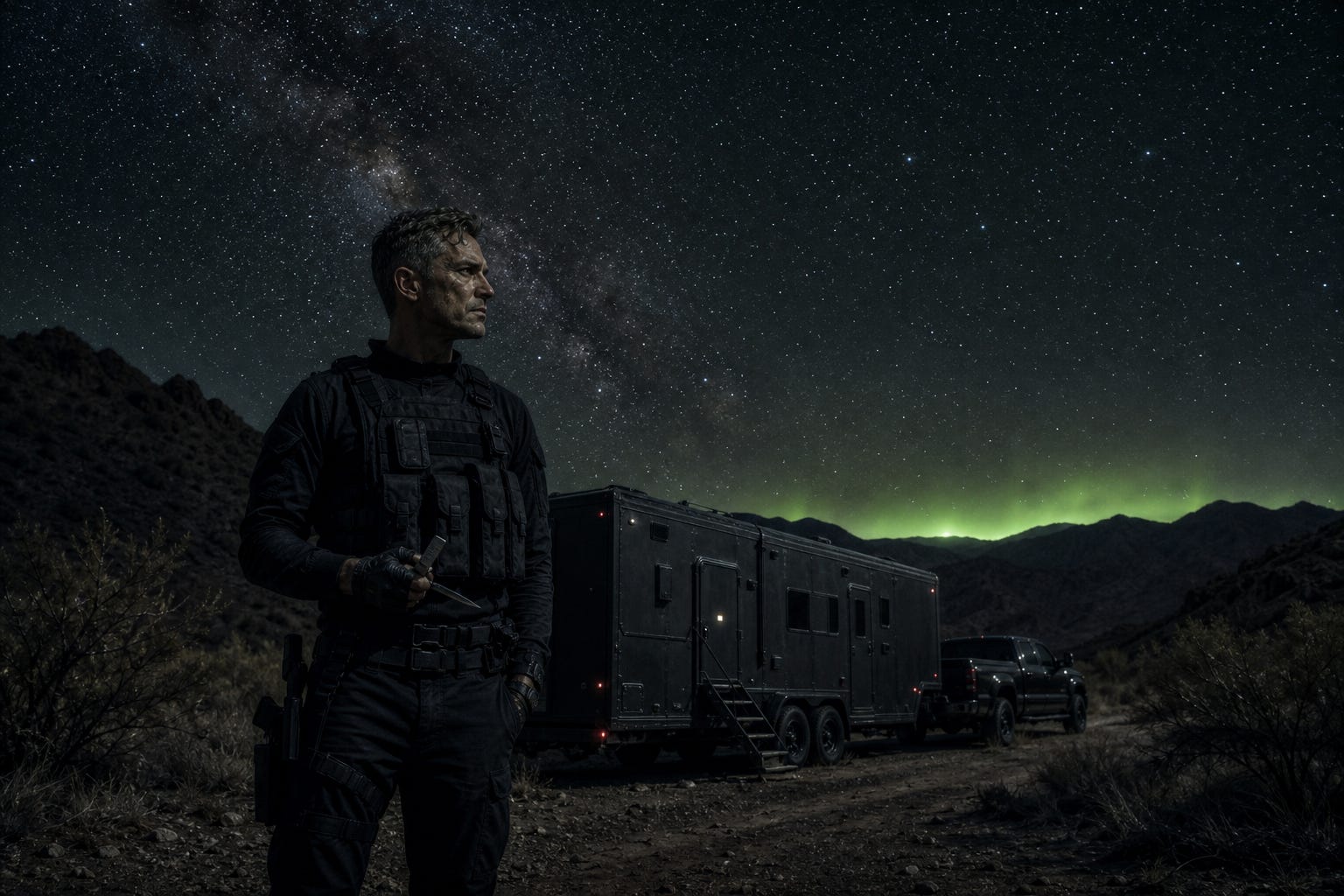
Warren pulled up to DeJesus and Associates at 2345 hours sharp, his black F-350 rumbling to a stop outside the darkened storefront. The truck was built for operational flexibility—heavy enough to haul gear through unforgiving terrain, armored enough to handle whatever waited at the end of the road. Tonight he’d left his mobile ops trailer back at his forward operating base in Marana. This felt like a face-to-face kind of job.
He stepped out with the measured calm of someone who’d learned early that announcing danger was amateur hour. Six-two and lean, Warren moved like violence was an option he kept on standby but didn’t advertize. Tactical blacks, Kevlar-wrapped jacket with concealed holsters, boots that wouldn’t betray his position on questionable ground. His short dark hair showed more silver than it had during his last Tucson rotation, and the knife scar down his left cheek caught the streetlight like a map of old business. Storm-gray eyes swept the AO out of habit—you stayed alive by never assuming the perimeter was secure.
One hand worked a folding knife open and closed in a rhythm older than conscious thought. The other stayed loose near his concealed sidearm.
The office door opened before he reached it.
“Sterling.” Ulysses DeJesus stepped into the desert night, face carved from shadow and moonlight. Lean, precise, moving like a blade that had learned manners. His charcoal suit was tailored to conceal the shoulder holster, and his dark eyes held the weight of too many cases that ended in chalk outlines. “Been a while.”
“Still breathin’. That’s somethin’.” Warren’s drawl carried years of Carolina back roads and operational fatigue. “You sounded spooked on the phone. That ain’t your usual style.”
“Spooked’s one word for it.” Ulysses stepped aside, gesturing toward the interior. “Street’s got ears. Come on in.”
Warren followed him through the door, automatically cataloging exits and sight lines. Old habits. “Appreciate you keepin’ it off the wire. Denver to Tucson ain’t exactly a short hop.”
“Wouldn’t have pulled you if it wasn’t necesario.” Ulysses closed the door behind them, sealing off the desert silence. “I know you had operations running up north.”
They settled into the comfortable atrium, Warren taking the chair that covered the entrance while Ulysses claimed the center of the couch. Professional courtesy between operators who’d worked together before.
“So,” Warren said, setting his knife on the coffee table within easy reach, “what’s got Tucson’s finest private dick calling in favors at midnight?”
“Remember that Skinwalker job you handled for Bishop couple months back?”
“Hard to forget.” Warren’s expression didn’t change, but his fingers stilled on the knife handle. “Clean op. Minimal collateral. Target eliminated.”
“Professional work. Impressed the hell out of the old lady.” Ulysses leaned forward. “She wants you on something else. Something worse.”
“Worse than Skinwalker?”
“Kids, Warren. Vampire kids. Claudias.”
The temperature in the room seemed to drop ten degrees. Warren’s jaw tightened, and when he spoke, his voice carried the edge of someone who’d seen too many horrors wearing innocent faces. “You’re shittin’ me.”
“Wish I was. We’re talking pre-teens, teens. Created young, dumped at the border like garbage. No training, no resources, no backup. Just pointed north and told to avoid daylight.”
“Jesus Christ.” Warren ran a hand through his hair. “That ain’t even warfare. That’s fucking child abuse with fangs.”
“Gets worse. Intel suggests it’s systematic. Someone’s hijacking established supply chains, turning the cargo, then using them as walking federal bait. Military-grade coordination.”
Warren went very still. In his experience, that kind of stillness preceded either tactical planning or extreme violence. “You’re telling me someone’s weaponizing dead children to start a war.”
“That’s the sitrep.”
Warren was quiet for a long moment, staring at something beyond the office walls. When he spoke, his voice was flat and cold. “I’ve seen a lot of ugly in my time. Sarajevo. Fallujah. Places where kids get caught in crossfire and worse.” He looked up, meeting Ulysses’ eyes. “But this? Turning children into monsters and abandoning them? That’s a special kind of evil.”
“Thought you’d see it that way.”
“Damn right I do.” Warren’s accent thickened with anger. “Back in Iraq, we had rules about kids. Lines you didn’t cross, no matter what. This shit…” He shook his head. “Whoever’s running this operation needs killin’. Permanent-like.”
“That’s where you come in. Vera’s handling the cleanup—rounding up the strays, making noise. You get the source. Quiet and surgical.”
“Good.” Warren picked up his knife again, testing the edge with his thumb. “Any intel on the primary target?”
“Kid I interrogated mentioned ‘Bat-face.’ Real horror show, from the sound of it.”
“Disfigured. Probably running counter-intel, which explains why your leads keep evaporating.” Warren nodded slowly. “Someone with that kind of scarring usually has professional reasons for staying invisible. Military background, maybe. Or cartel.”
“Could be both. This level of coordination…” Ulysses shrugged. “Takes someone who understands operational security.”
Warren was quiet again, processing implications. Finally: “Why me specifically? You could’ve called in other operators.”
“Because you’re clean. Off-grid. And because…” Ulysses hesitated. “Because you understand what it’s like when someone you trust turns out to be something else entirely.”
The words hit like a physical blow. Warren’s fingers tightened on the knife handle, and for a moment something raw and ugly flickered behind his professional mask. “Sofia.”
“She made you, then bailed to go play junkie with street addicts. Left you wondering what the hell you did wrong, didn’t she?”
Warren’s voice went deadly quiet. “That ain’t operational intel.”
“It is when it affects how you work. Sofia saw your potential, used your skills, then threw you away like yesterday’s intel report. Sound familiar?”
“Point taken.” Warren set the knife down carefully, as if it might explode. “These Claudia kids… someone saw their potential too. Used them. Threw them away.”
“Exactly. Question is: you gonna let that stand?”
Warren looked up, and his smile was winter steel wrapped in Southern politeness. “Hell no. Someone wants to play professional warfare with dead children? Time they learned what happens when you piss off an actual professional.”
“Thought you might feel that way.”
“What’s my operational freedom?”
“Full tactical autonomy. Bishop signed off on whatever resources you need.”
“Good. Because whoever’s running this shit show is about to discover something about the laws of war.” Warren stood, sliding the knife into its sheath with practiced ease. “You don’t make soldiers out of children. And you sure as hell don’t abandon them to die alone in the desert.”
“When do you start?”
Warren checked his watch. “Already started. Soon as I walked through that door and heard ‘vampire kids,’ this became personal.” He looked at Ulysses, and his drawl carried the promise of violence delivered with surgical precision. “Whoever Bat-face is, he’s got maybe forty-eight hours before I come calling. And when I do…”
He left the sentence hanging, but Ulysses got the message. In his line of work, you learned to read the difference between threats and statements of fact.
This was definitely the latter.
“One more thing,” Warren said, pausing at the door. “These Claudias still out there—the ones Vera’s hunting. They’re victims, not targets. Whatever cleanup operation she’s running, make sure she remembers that.”
“Will do.”
Warren stepped back into the desert night, already running tactical scenarios. Somewhere out there, someone was playing god with children’s lives, turning innocence into weaponized horror.
Time to remind them that some games came with permanent consequences.
His truck roared to life, and Warren Sterling disappeared into the darkness like a promise kept in advance.
He took I-10 southeast, cut off before Benson, and followed a weathered county road into the Dragoon foothills. The roads were unlit, unlined, and mostly empty. Just enough signs of life to keep a man from pretending he was in the middle of nowhere. But close.
That was the point.
He didn’t listen to music.
Back in Tucson. Again. Could’ve stayed gone. Should’ve. But then Bishop called. Paid a premium to interrupt his op in Denver. Said it mattered. Said it was personal. That meant this wasn’t recon or cleanup, it was legacy. Quiet, high-stakes, no real rules. Which meant someone wanted it done right, or buried deep. He didn’t much care which. Not really.
The land felt older here than the briefings ever admitted. The Dragoon range didn’t hum like the north. It held its breath. He’d been in country like this before, mountains that remembered. Places that didn’t forgive. Places with watchers.
Desert Demons. He didn’t believe in them the way the tourists did, but he’d seen the aftermath of things that didn’t line up. Shadows with teeth. Voices at wrong hours. Survivors who lied to themselves to stay sane. Not spirits. Not myths. Something worse.
Doesn’t matter what’s true. Just matters if it moves.
The diesel engine rumbled steady beneath him, a mechanical heartbeat against the desert silence. Wind moved across the windshield like something exhaling slowly. He kept his gaze steady, low beams cutting through the darkness, eyes flicking occasionally to the rearview. Nothing followed. Nothing had reason to.
His custom trailer tracked behind him like a coffin with wheels, silent, sealed, and full of tools no one else touched. Mobile command post, armory, and safe house all rolled into eighteen feet of reinforced steel. Everything a man needed to disappear or make others disappear, depending on the mission parameters.
Might be I’m getting too comfortable with this work. Used to feel something when I loaded up for operations like this. Now it’s just another Tuesday. Bishop calls, I roll, things get handled. Simple. Clean. Efficient.
Maybe that should worry me more than it does.
By 0343, he had pulled off onto a forgotten dirt cut between two creosote ridges.
Dark out here. Not just night-dark, desert dark. No sodium wash, no suburban haze. Just stars like needles and a sky so wide it forgot how to echo. He’d checked the Dark Sky maps before rolling out—this pocket of Cochise County was prime Milky Way country. Perfect for long exposure shots, amateur astronomy.
Or things that didn’t want to be seen until they were right in front of y’all.
As the truck slowed, something strange shimmered along the horizon, a low ripple of pale-green light that danced like an aurora, but too dim, too slow, and entirely out of place. The desert sky above remained moonless and clean, but along the ridgeline, the air shimmered like something had exhaled across the stars and bent them.
It lasted maybe five seconds.
Huh. That was weird.
Not lightning. Not heat distortion. Just a wave. And then it was gone.
He made no note of it. Nothing to mark. Nothing to chase. Just a shimmer and a stillness. Could’ve been atmospheric. Could’ve been equipment reflection. Could’ve been his eyes playing tricks after six hours of night driving. Or could’ve been something else entirely.
File it under “things that don’t line up” and keep moving. Been down that rabbit hole before.
The GPS confirmed the location: five miles northwest of Cochise Stronghold proper. Elevation steady. Drainage reliable. Cell tower radius minimal. Flat enough to anchor. High enough to watch. Low enough to vanish.
He exited the cab. Crushed gravel whispered under his boots. No animal trails. No boot prints. No wind. Just stillness that felt like something holding its breath.
He walked the perimeter before unloading. Fifty-meter radius. Standard operational protocol, even for safe-zone establishment. Old habits die hard, and the ones that kept him breathing died harder than most. He noted three subtle breaks in terrain where water had cut through the slope; erosion markers. Good. They’d keep the trailer hard to track from the air. He clocked a single dead saguaro collapsed at the western boundary. Something had stripped the skin from it, clean and smooth, exposing pale ribs underneath, like bone.
Strange. Vandalism, maybe. Or wildlife. Desert’s got its own rules about what lives and what gets picked clean.
He logged it but moved on.
Anchoring took thirty-six minutes. He drilled rebar into the gravel and caliche-packed red clay substrate, bolted the trailer’s weight-bearing frame into a pre-fabricated cradle, then dusted off his hands. Muscle memory from a dozen deployments. Set up fast, set up right, set up to leave in a hurry if the situation called for it.
As he worked, he found a ring of small stones near the east side, each no larger than a child’s fist, stacked into a spiral just wide enough for a body to lay curled inside.
He froze.
It wasn’t new. Lichen clung in the cracks. One of the stones was stained dark, like desert varnish, thin and permanent, baked in by time and wind. But this wasn’t random. This was intentional. Designed.
Ritual circle. Question is, what kind of ritual?
He circled back to the spiral once the anchors were set. He didn’t want to, but the shape kept pressing at the corner of his vision. From a distance, it still looked like a forgotten campfire ring, Boy Scouts, or amateur survivalists. The kind of thing someone built once, then left to be copied over and over without meaning.
But up close, the center of the spiral told a different story.
The dirt was glassy and fractured, fire-baked from years of use. The ash-blackened stones on the rim were sun-bleached, easy to shift. But the ones toward the center? He nudged one with a boot. It didn’t budge.
Set deep. Like someone put them there to hold weight. Real weight.
Not a fire. Not a ritual. Something else. Something that needed… anchoring.
His Beast coiled. Not in warning. Just recognition.
They touched this place. So did we. You just forgot.
The memory hit him like muzzle flash in the dark.
Afghanistan. 2004. Different mountains, different desert, but the same wrongness in the air. His squad had found the village after three days of radio silence. The locals were gone—all of them. Just empty houses and a circle of stones in the center of what used to be the market square. Blackened earth in the middle, like something had burned hot enough to turn sand to glass.
“Ritual site,” the interpreter had whispered, refusing to get closer. “Bad spirits. Very bad.”
Warren had cataloged it in his report as “unknown cultural practice—possible religious significance.” But he’d seen the fear in the interpreter’s eyes. Real fear. The kind that came from knowing what those stones were really for.
Three months later, the skinwalker hit their forward operating base. Half-human, half-nightmare, skin stretched wrong over bones that shifted as it moved. His rifle barrel heating up from the incendiary rounds, brass ejecting like desperate prayers, watching the thing shrug off bullets like they were raindrops.
Took thermite and a lot of luck to put it down. But even burning, it had looked… familiar. Like something that had been bound once, then set loose.
He didn’t touch the spiral again.
Instead, he walked a few meters west and placed his portable dish. As he adjusted its tilt, his Beast stirred again, not hunger, not warning. Something else.
This place is wrong. Not for you. Not yet.
He dismissed it. Set the dish. Buried a motion sensor in the gravel. Watched the ground like it might answer back. The desert had rules. Some of them weren’t written in any manual he’d ever read.
Bishop was clear about the target—vampires manufacturing the Claudias. Question is how deep this operation goes and whether they’ve got military-grade coordination backing them. But operational security cuts both ways—sometimes you don’t reveal all your intel going in. Keeps the enemy guessing. And this spot’s perfect for the mission parameters. Close enough to the border for quick egress, isolated enough that nobody’s gonna stumble across the operation.
At 0457, he stepped inside the trailer. The interior was all business—reinforced walls, encrypted communications array, weapon lockers, and a narrow bunk that had seen too many nights like this. Climate-controlled, soundproofed, and designed to function as both command center and last stand.
He locked the door. Multiple deadbolts, electronic locks, pressure sensors. Then sat in the dark. Didn’t light anything. Just watched the wall-mounted displays cycling through perimeter feeds.
Y’all can plan all you want, but the desert’s got its own schedule. Thing about operations like this—you can’t force contact. You just set up shop and wait for whatever Bishop thinks is out there to show itself.
He didn’t pray. Didn’t breathe deep. Didn’t think too hard about stone spirals or green lights or the way certain places felt like they were listening. Just waited. For orders. For movement. For Bishop’s legacy to reveal what the hell she’d dragged him back for.
Been in worse spots. Been in quieter spots. This one’s different, though. Feels like standing in a graveyard where the headstones got moved, but the bodies stayed put.
The perimeter sensors showed nothing. No movement. No heat signatures. No electromagnetic anomalies beyond the standard desert baseline.
But the stones were still there. Still holding whatever they’d been placed to hold.
And somewhere in the dark, something was fixing to remember why that mattered.
Outside, the wind returned. Just a little. And under the gravel, something stayed still. Just still enough to feel like listening.
Let it listen. Been through worse than whatever’s out there waiting. And if Bishop’s right about this place…
Well. Reckon we’ll all find out soon enough.
He waited.