
TBD (The House Girls) - Chapter 1 (Pre-Release Draft)
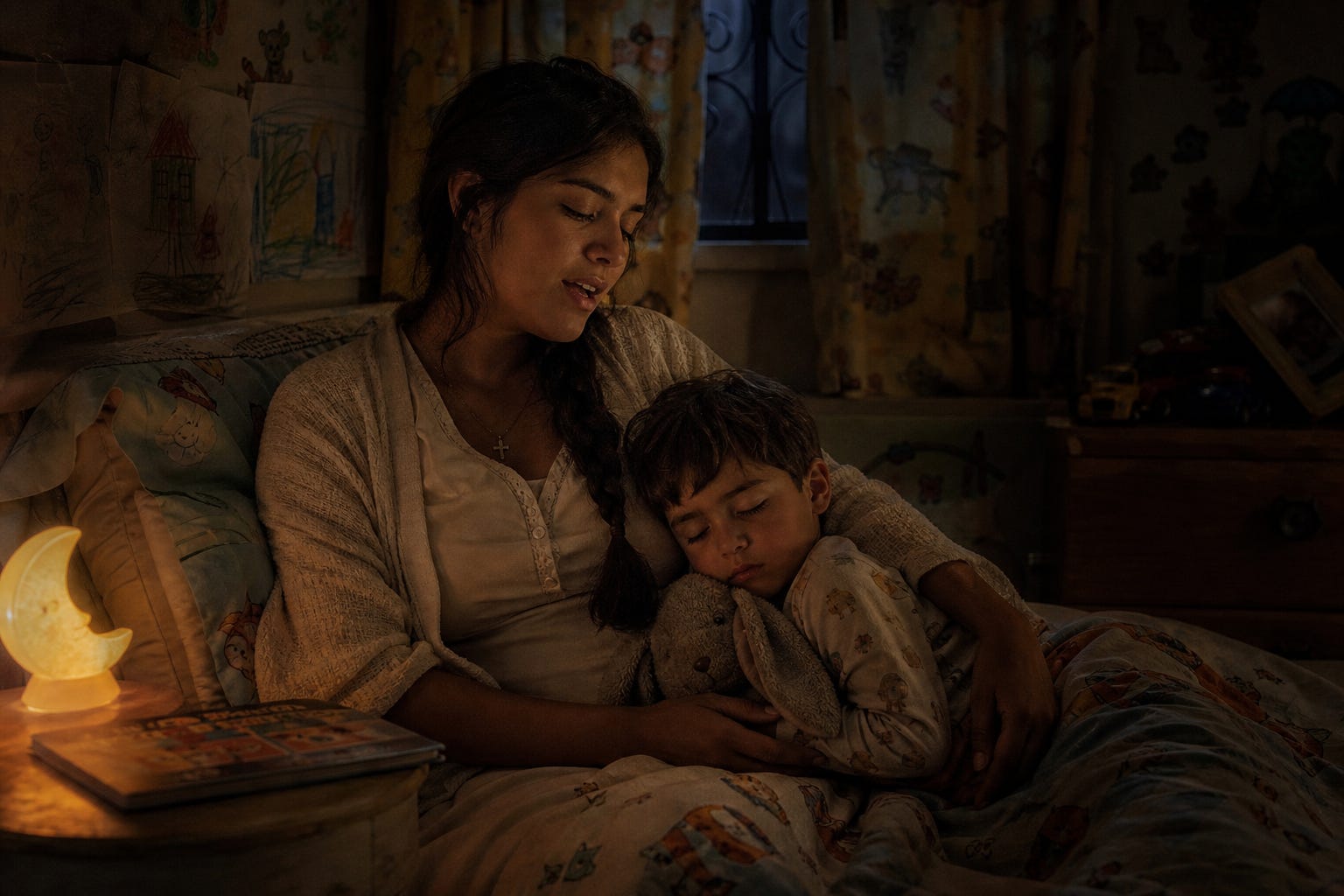
She rolled toward the small bed beside hers, where Asher lay beneath Beatriz’s old manta de bebé. His breathing came in those heartbreaking hiccups she’d learned to recognize—the rhythm of a child crying himself to sleep. Even unconscious, his small face remained pinched with the particular tension of a four-year-old trying to process the impossible.
Pobrecito. Two days since Daniel had dropped him off with nothing but a name and orders to “take care of him.” Two days of rotation shifts among the girls, each trying to comfort a child who wouldn’t stop asking for his mother in that small, broken voice that made Lucia’s chest ache in ways she couldn’t explain.
“Mira, mi amor,” she whispered, smoothing his dark hair. “Tía Lucia is here. You’re safe.”
Something twisted in her stomach at the word safe. Since when had 142 W Elm Street felt unsafe? Vera took care of everything—their medical, their food, their protection. The house on Elm was their sanctuary between shifts at the Cabaret, where they had cable television, a gym, and rooms that locked from the inside. It was more than most of them had ever known.
So why did she keep checking the locks twice now? Why did her skin crawl every time she caught a glimpse of her own reflection, like something fundamental had shifted that she couldn’t quite remember?
Asher stirred, whimpering. “Mommy…where’s my mommy?”
Lucia slipped from her bed, kneeling beside his smaller one. “Shh, mijo. Tía is here.”
His eyes opened—dark and lost, swimming with tears that seemed too large for his small face. “I want my mommy. The bad people took her.”
“I know, corazón. I know.” She reached out slowly, letting him decide whether to accept comfort. He grabbed her hand with both of his, tiny fingers desperately clutching hers.
“What’s core-a-zone?” he asked through his tears.
“It means sweetheart. Like when your mommy called you special names.”
The touch sent another flash through her mind—hands on her throat, but different hands. Colder. Stronger. The memory scattered before she could grasp it, leaving only a sick feeling in her stomach and an overwhelming need to protect this small, broken boy.
“Will you stay with me?” Asher’s voice was barely a whisper.
“Sí, I’ll stay. Tía Lucia won’t leave you.”
She settled on the carpeted floor beside his bed, back against the wall, still holding his hand. The house felt too quiet around them—no television chatter, no voices from the kitchen, no footsteps on the stairs. The other girls were all at the Cabaret, working the late shift that would keep them busy until three in the morning. Lucia should have been there too, but Vera had given her the night off. “You still look pale, mija,” she’d said, though Lucia couldn’t remember why she should look pale or what had happened to make Vera concerned.
The silence pressed against her eardrums, broken only by the house settling and the distant hum of the refrigerator two floors down. Even the usual sounds of Elm Street—cars passing, neighbors’ televisions, the occasional police siren—seemed muted tonight.
Just her and Asher, alone in a house that felt too big and too empty.
But underneath it all, Lucia sensed something had shifted in their carefully maintained world. Not just Asher’s arrival—though that was part of it. Something more personal, like a thread had been pulled loose in the fabric of her own reality.
“Tía?” Asher’s voice pulled her from her thoughts.
“Qué pasó, mi amor?”
“Do you think my mommy is looking for me?”
The question hit like a physical blow. Lucia had learned not to ask too many questions about the children who occasionally passed through their lives—Daniel brought them, Vera made arrangements, and they learned not to get attached. But this time felt different. This time, no one had explained anything beyond “take care of him.”
She studied Asher’s face in the dim light, cataloging details the way trafficking had taught her to read people. The particular way his shoulders hunched when he mentioned his mother. How his left hand kept reaching for something that wasn’t there—a blanket, maybe, or a stuffed animal. The careful way he asked questions, like he’d learned that some answers could hurt.
This wasn’t just ordinary childhood trauma. This boy had seen something that broke more than his sense of safety.
“I think…” Lucia chose her words carefully, “your mami would want you to be safe. To eat your food and sleep when you need to sleep. To let the tías take care of you while she… while she can’t.”
While she can’t. Not while she’s away or until she comes back. Something in Lucia’s gut told her that Asher’s mother wasn’t coming back, though she couldn’t say why she knew this or how.
“I miss her.” His voice broke on the words.
“Lo sé, mi vida. Missing someone just means you love them very much.”
“What does ‘me vida’ mean?”
“Mi vida means ‘my life.’ It’s what we call someone very precious to us.”
Asher considered this gravely. “My mommy called me her little man.”
Asher studied her face in the dim light filtering through the curtains. “Are you sad too, Tía?”
The question caught her off guard. Was she sad? She felt… hollow. Confused. Like something important had been taken from her, but she couldn’t remember what.
“Sometimes we get sad, and we don’t know why,” she said finally. “But that’s okay. We can be sad together.”
“Will you sing to me? My mommy used to sing.”
Lucia’s throat tightened. She hadn’t sung anything since… since when? The memory felt just out of reach, like trying to remember a dream after waking.
“Duérmete mi niño, duérmete mi sol,” she began softly, the lullaby rising from some deep place in her memory. “Duérmete pedazo de mi corazón.”
Asher’s grip on her hand relaxed slightly as her voice filled the small space between their beds. The melody came easily, though she couldn’t remember learning it. Perhaps her own mother had sung it to her, back before the streets and the cartel and Vera’s golden cage.
“Este niño lindo que nació de día, quiere que lo lleven a la dulcería.”
As she sang, Lucia felt some of the tension in her shoulders ease. The phantom flashes of teeth and cold hands seemed to retreat, replaced by this moment of simple comfort. Here was something she could do. Here was something that mattered.
When the last notes faded, Asher remained quiet for a long moment, processing. Then, with the sudden topic shifts of childhood, he said, “The other tías like you.”
“Sí? How do you know?”
“Tía Cecilia said you have kind eyes. And Tía Daniela gave me extra cookies when I asked for you this morning.”
Lucia smiled despite herself. Trust Daniela to show affection through food. “The tías all care about you, mijo. We want you to feel safe here.”
“I like you best though.” His confession was matter-of-fact, the brutal honesty of a four-year-old. “You don’t look at me like I’m broken.”
The words hit harder than Lucia expected. Did the others look at him that way? Or was Asher simply recognizing something familiar in her—the particular brand of careful distance that trauma taught?
“You’re not broken, corazón. You’re hurt. That’s different.”
“Are you hurt too?”
Lucia considered the question. The flashes of teeth. The way her skin crawled when she looked in mirrors. The inexplicable urge to check locks and avoid dark corners.
“Maybe a little,” she admitted. “But hurt things can heal. And healing is easier when you’re not alone.”
Asher nodded solemnly, accepting this wisdom with the gravity children brought to important truths. “Can I sleep in your bed? I promise I won’t kick.”
Every protective instinct Lucia possessed screamed yes, even as her practical mind reminded her about boundaries and rotation schedules. But this wasn’t about schedules. This was about a child who had lost everything finding comfort with someone who understood loss, even if she couldn’t remember what she’d lost.
“Claro que sí. Come here, mi amor.”
She helped him transfer to her larger bed, settling him against the pillows before lying down beside him. Asher immediately snuggled down against her side, small and warm and trusting in a way that made her chest ache. A tiny little spoon to her big spoon.
“Tía Lucia?”
“Qué?”
“Will you tell me about when you were little?”
The request should have been simple. Every adult had childhood stories—first pets, favorite foods, games with friends. But when Lucia reached for those memories, she found mostly darkness punctuated by fragments: hunger, fear, adults who weren’t safe. The storm drain where the cartel found her.
“When I was little, I lived Ciudad Mante, in Tamaulipa,” she said carefully, “I liked to look at the stars. Even when everything else was scary, the stars were always the same.”
“Can we look at stars tomorrow?”
“Sí, we can look at stars.”
Asher settled deeper against her side, his breathing already evening out toward sleep. But his next words stopped her cold.
“The bad man who took me and Mommy had scary teeth.”
Lucia’s blood turned to ice water. Flashes exploded behind her eyes—fangs, inhuman strength, cold hands and colder intentions. The images came faster now, too quick to fully process but impossible to ignore.
“Asher,” she managed, “what did the bad man’s teeth look like?”
But he was already asleep, exhausted by grief and the effort of being brave. Lucia lay awake beside him, staring at the ceiling as fragmented memories tried to surface.
Teeth. Cold hands. Something wrong about Kyle’s eyes that night at the Cabaret, though she couldn’t remember exactly when or why she’d noticed.
Whatever had happened to her, whatever those flashes meant, they connected her to this child in ways beyond simple kindness. They were both survivors of something monstrous, even if only one of them could remember it clearly.
Lucia felt something fundamental shift inside her chest—not the hollow ache that had haunted her for days, but something fierce and protective. She’d spent years learning to survive in a world that treated her as disposable. She’d made peace with being a commodity in Vera’s operation because it was still better than the alternatives she’d known.
But this child would never be disposable. Not while she drew breath.
“I won’t let anything hurt you,” she whispered into the darkness, the words carrying the weight of every hard lesson the streets had taught her. “Te prometo, mi niño. Nothing will hurt you while I’m here.”
The vow settled into her bones like an anchor, giving her something solid to hold on to amid the confusion of fragmented memories and unexplained fears. In the morning, there would be questions about rotation schedules and boundaries. Vera would want reports on Asher’s adjustment. The other girls would need reassurance that Lucia wasn’t overstepping.
But tonight, there was just this: a broken woman and a lost child finding safety in each other’s presence. Two survivors recognizing their own reflection in each other’s wounds, choosing to build something protective from the wreckage of what they’d lost.
Outside, Tucson settled into the deep quiet of predawn hours. Inside 142 W Elm Street, something new and protective had awakened—a bond forged in shared trauma and sealed with lullabies sung in Spanish, promising that neither of them would face their nightmares alone.
Lucia closed her eyes, one hand resting protectively on Asher’s small back where she could feel his heartbeat steady and strong beneath the thin cotton of his borrowed pajamas. For the first time in days, the flashes of teeth stayed away. In their place came something she hadn’t felt since before the cartel, before the streets, before she’d learned that safety was always temporary: the quiet certainty that this mattered. That this was worth protecting. That some things were worth the risk of caring.