The seven o'clock let out at ten to eight, as it always did, because Doña Refugio Salcido needed ten full minutes to get from the second pew to the doors on her walker, and nobody at St. Dismas had ever been willing to start the recessional hymn without her.
Tomás stood in the vestibule with his back to the holy water font and shook hands. The floor was the original 1912 tile, small black and white hexagons with a crack running corner to corner where the boiler men had dropped something in the sixties, and every November the draft from the street doors found that crack and came up through it. The parishioners buttoned their coats against it. He left his open.
"Buenas noches, padre."
"Id con Dios."
Refugio stopped the walker level with him and did not let go of his hand. She was eighty-one. She had buried two husbands and a son out of this building.
"You look well," she said. "Better than when you came."
"It's the hours. Nobody ages at night."
She laughed and patted his knuckles and went out into the cold on her grandson's arm, and the vestibule emptied behind her until one man was left in it.
He had been standing by the bulletin board since the Our Father. Black clerical suit, black overcoat, gray at the temples and nothing on top. He had stayed in the back pew through communion with his hands in his coat pockets. Tomás had noted that from the altar and filed it with the other things a priest notes from an altar: who stays seated, who leaves after receiving, who cries.
The man turned from the board, and Tomás knew the face a moment before he knew the name. Walter Mazur. Mundelein, class of 1999, two seats down through four years of moral theology, the one who ate the orange peel off everybody's lunch tray because his mother had told him that was where the vitamins were. He had been heavy then. At fifty-three it had settled into his neck.
"Tom," Mazur said.
Nobody had called him Tom since seminary.
"Walt. You're a long way from Bridgeport."
"Six miles." Mazur did not come closer. He had put himself between Tomás and the street doors without seeming to decide to, and his right hand had not come out of his coat pocket. "You look good."
"How's the parish?"
"You look exactly the same. I want you to hear that I'm not saying it the way people say it."
Tomás said nothing. It was the most useful thing he knew how to do, and Mazur had sat through the same pastoral counseling seminar and would know it for what it was, and it worked on him anyway. He took a manila envelope out of his inside pocket with his left hand and held it out at arm's length. When Tomás did not take it, he shook two photographs out of it himself and turned them around.
The first was the steps of Holy Name Cathedral in May of 1999. The Cardinal in the middle, fourteen new priests in two rows squinting into the sun, and on the end of the back row a slight, dark young man of twenty-six in a borrowed chasuble that was too long for him. Tomás had not seen his own face on paper in a quarter of a century. He had expected it to look younger than it did.
The second was the same steps in May of 2024. The silver jubilee Mass. Twelve of the fourteen were still living and eleven had come, heavier, balder, two of them on canes, and on the end of the back row, where Tomás had stood because he always stood on the end, there was a gray streak the height of a man, doubled at the shoulders, as if somebody had breathed on the lens.
"My mother framed the first one," Mazur said. "The photographer reshot the second one three times and then he blamed the humidity. I blamed the humidity too. For two years I blamed the humidity."
"What changed?"
"A man came to my rectory in June." Mazur's voice had gone flat and careful, the voice for reading the banns. "Hector Quiroga. He said a priest at a shelter in Pilsen heard his confession and then took it out of his head, and now all he has is the kneeling. I gave him the number for Catholic Charities. Then he told me the priest won't show up on his phone." He put the photographs back in the envelope with one hand, clumsily, bending a corner. "I've got a lot of people who tell me things, Tom. I've got one who told me that and then showed me the video. You're a smear on the wall of a soup kitchen."
Quiroga. Of course Quiroga.
"What did you tell him?"
"That I'd pray on it." Mazur set the envelope on the rim of the font, and his right hand came out of his pocket. "I prayed on it for five months."
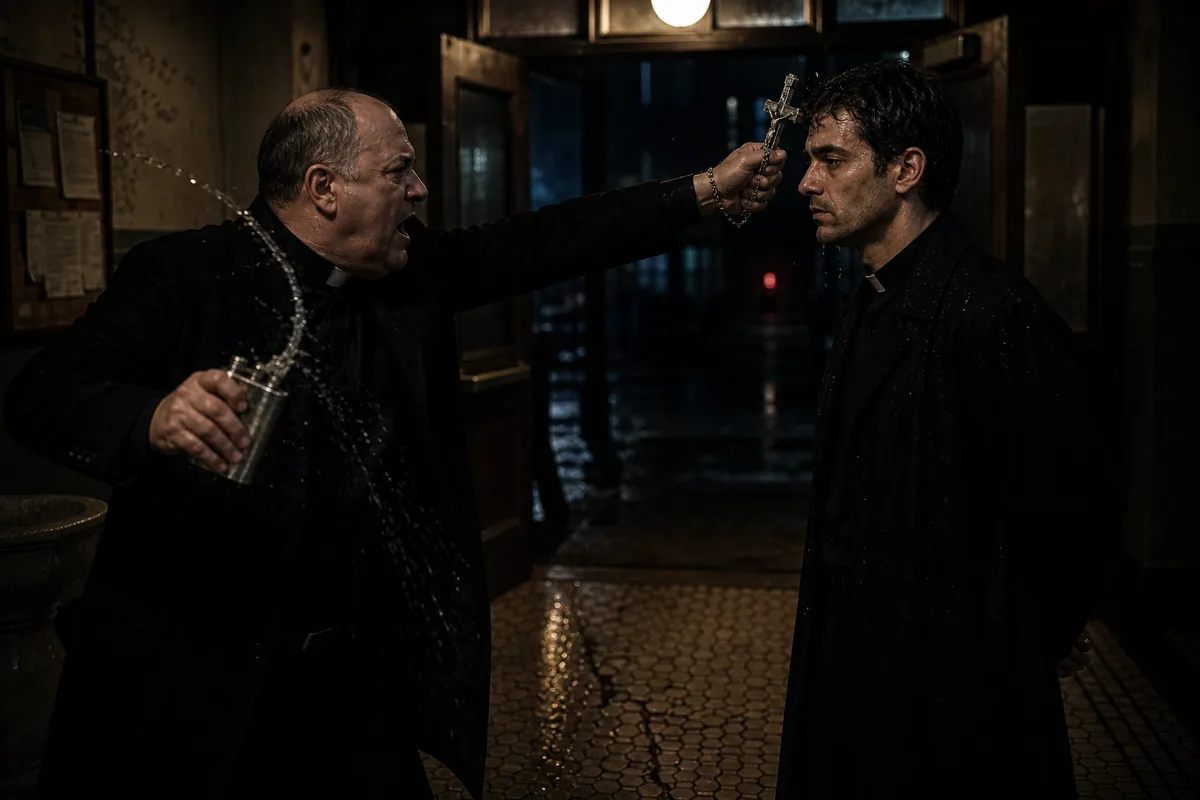
The crucifix was silver, the length of a man's palm, on a chain he had wrapped twice around his knuckles so it could not be knocked away. It had been worn smooth at the feet where a thumb had rubbed it for a lifetime. In his left hand he had a steel hip flask with the cap already off.
"It was my father's," Mazur said, meaning the cross. "He carried it at the Chosin Reservoir. The water I blessed myself at noon. The old rite. Salt and all." He swallowed. "I didn't use your font."
"You could have."
"I didn't know who blessed it."
"I did."
Mazur took that in. His face did not know what to do with it, and so it did nothing, and for a moment the vestibule was so quiet that Tomás could hear the radiator ticking in the confessional behind the inner doors.
Underneath the quiet, the thing that lived in him lifted its head.
He came here to kill you. Open him before he finishes the first line.
Tomás put his hands behind his back, where they could not do anything, and took hold of his left wrist with his right hand. He moved his feet apart on the tile and stood as he stood at the altar for the long prayer, and he let the coat hang open.
Do it properly, Walt. Do all of it. Please.
He wanted it. He had not known until that moment how much. If the water burned then the Church was real, and if the Church was real then somewhere inside it there was a man with the standing to hear his confession, and he would find that man if he had to walk to Rome on his own two feet by night. Every other priest he had stood in front of had been a man holding an empty cup. This one had come with his father's cross and a flask blessed at noon, and he was frightened enough to mean it.
Venga. Venga, por favor.
"In nomine Patris," Mazur said, "et Filii," and threw the water.
It hit Tomás across the face and the collar and ran down inside his shirt. Salt on his lip. Cold, which meant nothing, because he was always cold. He waited for the rest of it, for the skin to go, for the smell, and the water ran down his throat to his chest and soaked into his undershirt and stayed water.
Mazur came forward, and pressed the crucifix to his forehead, and began.
"Exorcizo te, immundissime spiritus, omnis incursio adversarii, omne phantasma, omnis legio..."
His Latin was good. It had been bad at Mundelein, Tomás remembered, the ecclesiastical pronunciation fighting a South Side vowel the whole way, and somebody in the twenty-seven years since had drilled it out of him. He had the rhythm right. He had the cases right. He pressed the silver hard enough to hurt a living man, and his whole arm shook with it.
You need the Cardinal's express permission for this. Canon 1172. You don't have it. It doesn't matter. Go on.
The silver was cold. Tomás was colder. After a while the metal took a degree of warmth from Mazur's hand, and that was everything that happened.
He found that he had leaned into it. His forehead was pressed against the cross, pushing, the way a man leans on a door he has been told is locked. Mazur felt the weight come on and his voice went up half a register and kept going. He shook out the rest of the flask. He made the sign over Tomás three times, and the water ran off the wool of the coat in beads and pattered on the tile, and Tomás stood in it.
He could feel the man. He always could, at this distance; it was how he knew a penitent through the screen before the man had found his first word. Mazur was terrified. Under the terror he was sincere, with the whole of himself, and under the sincerity there was conviction, entire and unexamined, the faith of a man who had never once been in a position where he had to check. Tomás went down through all three layers, as he had gone through his sire's texts for twenty-five years, looking for the seam. He was looking for the place where the faith was fastened to something.
It was not fastened to anything. There was the terror, and the sincerity, and the conviction, and under them, where the thing the conviction pointed at should have been, there was nothing at all.
"...eradicare et effugare ab hoc plasmate Dei..."
Mazur stopped in the middle of a word.
He took the cross off Tomás's forehead and looked at it, turned it over and looked at the back, as if it might have been switched for a cheap one somewhere between Bridgeport and here. He shook the empty flask. Then he tried it in English, the prayer to Saint Michael every altar boy in the Archdiocese had known by heart before 1964, loud enough that it came back off the plaster: "Saint Michael the Archangel, defend us in battle, be our protection against the wickedness and snares..."
He did not finish that one either.
"Please," he said, to nobody in the vestibule.
His knees went. He did not fall so much as sit down all at once on the wet tile, one hand still wrapped in the chain, and the envelope slid off the rim of the font and landed beside him face up.
Tomás let go of his own wrist. His forehead was wet. He wiped it with the heel of his hand and looked at the palm and there was nothing on it but holy water.
"What are you?" Mazur said.
"Wet."
Mazur made a sound that was not a laugh.
"I was hoping you'd tell me," Tomás said. "That's the honest answer. I stood still for it because I was hoping you would."
"It should have..."
"Yes."
"Then it's not..." Mazur looked at the cross in his hand. "Then none of it..."
Tomás did not finish the sentence for him. He had spent a great many years learning to leave another man's sentence where the man had put it down.
He crouched on the wet floor so their faces were level. Mazur flinched and then made himself not flinch, and Tomás counted that to his credit. It would have taken one word. Mazur would have gone home to Bridgeport tonight with a headache and an empty flask and no idea why he had driven six miles, and in the morning he would have found the envelope in his coat and thought it was about the jubilee. The thing that lived in Tomás approved of that plan very much.
He ran the experiment. He ran it clean. The result is his.
"Thank you, Walt," Tomás said.
Mazur stared at him.
"I mean it. You did it right. The water was valid, the rite was valid, and you meant every word. I could feel that you meant it." He stood, and his knees did not crack, because they never did now. "Nobody's ever done it right before."
He picked the envelope up off the tile and put it back into Mazur's coat pocket, carefully, so the corner would not bend further.
"Lock the doors when you go. The left one sticks. You have to lift it."
He went through the inner doors into the dark church. At the stoup he put two fingers into the water from habit and crossed himself, as he had every night for twenty-seven years, and the water was cold, and it was water. The sanctuary lamp was burning red over the tabernacle. Somebody had left a rosary on the end of the fourth pew. He picked it up to put in the lost and found and went on down the side aisle toward the sacristy passage with it in his hand.
About halfway, under the Stations, level with the eleventh, it occurred to him what he had just done. A man had come into this building with his whole life's faith intact and aimed, and Tomás had stood still for four minutes and let him watch it land on nothing. It had taken twenty-five years to do the same to Tomás, and he had thanked Walter Mazur for it.
He stopped with the rosary in his hand.
Mazur had not been a fraud. There had been no failure of nerve in that vestibule, no half-meant word, no shortcut in the rite. The faith was real. Every ounce of it was real, and it had been aimed at an empty chair, and so it had done precisely as much as an empty chair does. And he himself believed in something he had tested for a quarter of a century and could not break, and that had never once stood between him and anything either.
The same finding. He had come at it from the other side.
True faith only matters if what you have faith in is true.
He turned the sentence over twice and could not find the seam in it. He did not say it aloud. There was nobody in the church to say it to, and the one man who would have understood it was sitting in the vestibule on a wet floor, and was not ready.
Behind him, the street door did not open. He listened for it all the way to the rectory.
Leave a Comment
The Vestibule
There's no live comment thread here - your comment goes straight to the author's inbox.
By sending a comment, you agree to allow the author to share your comment publicly. Anything included in your submission — including your email address — may be made public. You have been warned.
Got it — thank you.