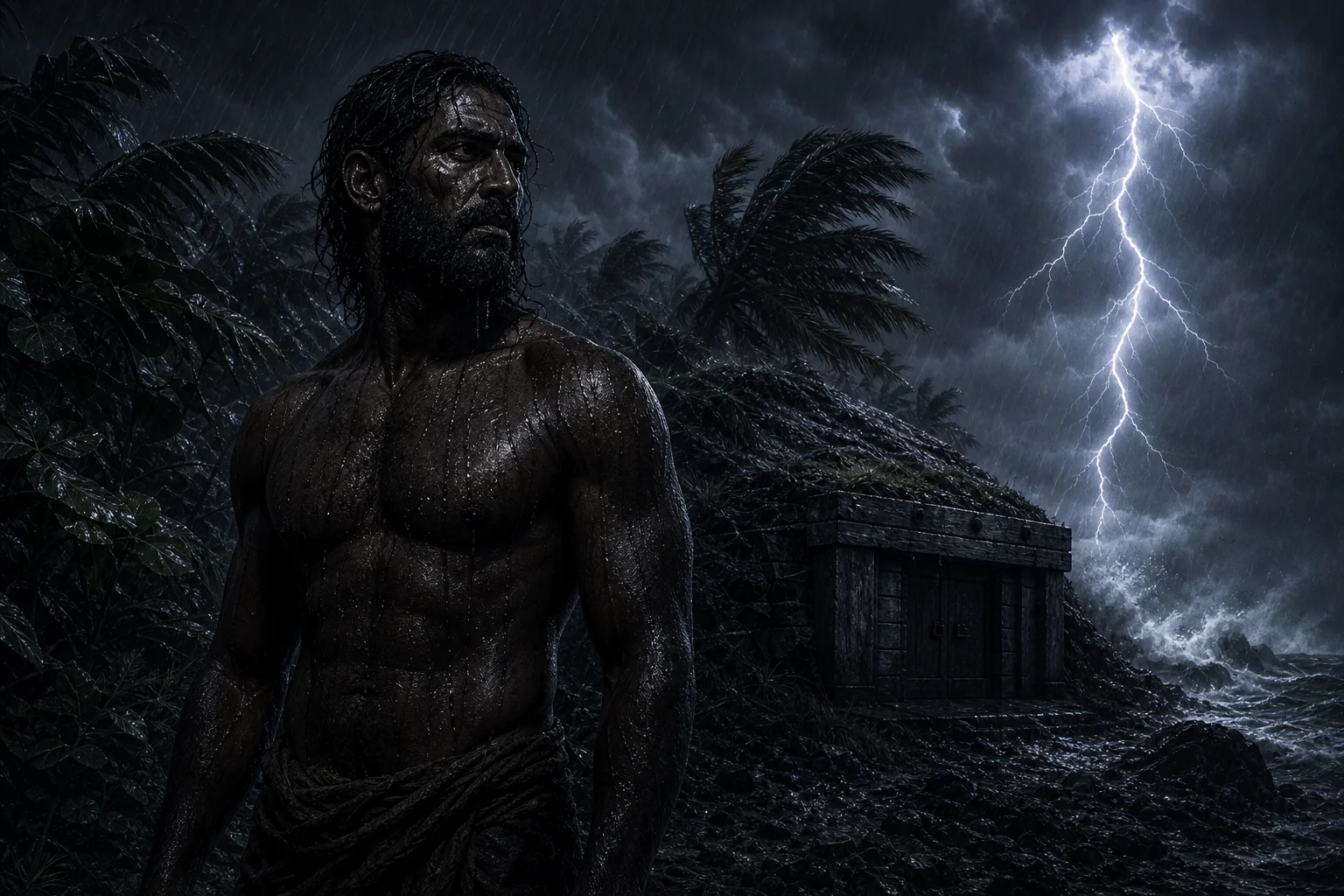
Twas about a year after I left the shores in search of adventure, that a great storm arose. A storm the likes of which I thought would end me and the ship I was on. It was as if the very hand of the Almighty himself was trying to drown us.
My captain ordered me to the deck to secure some of the lines, and there arose such a wave that I was cast over the side and into the storm-tossed maelstrom that was the sea.
Had I needed breath, I surely would have drowned, but being dead already, I survived and was tossed about the sea until I found myself arriving on stranger shores.
I will tell you first what I have learned of sailors, for a woman comes to know a great deal of men when she feeds upon their dreams. They are a superstitious lot. They will not sail on a Friday, nor say the word drowned within a hull, nor suffer a woman on the deck for fear she sours the wind. They carry their charms and their spitting and their small muttered prayers, and they believe every one, and not one of those charms had kept the sea from taking me whole. I had thought myself long past the age of tall tales. I was raised on but one true tale, which was that God had elected some souls to glory and reprobated the rest to burning, and that a body could not know which she was until the door had already shut behind her. Against a doctrine of that weight, a mermaid or a haunted cove is a child's comfort. So I believed in what I could touch, and in what could touch me, and by that year the list of things that could touch me had grown very short.
When I dragged myself from the surf onto the black sand, wrung through and furious and whole, I did not look for spirits. I looked for shelter.
The night was already old. I could feel the morning the way I had once felt a fever coming on, a pressure behind the eyes, a knowledge in the meat of me that the sun was turning somewhere beyond the water and meant to come for me. A year I had been dead, and a year is long enough to learn the one lesson my kind cannot afford to learn twice, which is that the day is a mouth and does not give back what it swallows. I had no ship. I had no hold, no cellar, no nook in the belly of anything that floated. I had an island I did not know and a sky that was already thinking about grey.
I had begun to dig with my hands into the wet earth beneath a stand of sea grape when I understood that I was not alone.
A man stood at the tree line above the beach. He had not called down to me, nor come near, nor made the sounds a living man makes when he wishes a frightened woman to know he means no harm. He only stood, and watched me claw at the ground like a dog after a bone, and waited for me to see him.
He was tall, of black hair, well muscled. Dark eyed. His skin was dark, as if a laborer had spent too many years in the sun. The color of rich leather, yet darker, as if the darkness could live inside a thing.
I came up out of my crouch with my hands full of sand, ready to run, or to fight, or to do the third thing, the thing I had learned in Portsmouth and had not left behind me on any shore since, which was to go soft and small and sorry and let a man believe he had happened upon something to pity. I had all three of them ready. I used none.
For he was not afraid of me, and he was not food.
I knew both at once and could not have told you how. A living man upon a dark beach, coming on a drowned woman who was not drowned, ought to carry some fear in him, and under the fear I ought to have felt the other thing, the warmth of him, the pull, the small red music that every living body plays whether it wills the playing or no. There was none. He stood there and my hunger did not so much as turn its head to look at him.
It was as if he knew I was arriving. Knew what I was, as he was the same.
"You will want to be under the ground before it comes," he said.
He came down the sand then, unhurried, and I saw that he walked like a man crossing his own dark room, sure of every step upon ground he had long ago stopped needing to see. He did not ask what I was. He did not ask how I had come to his beach, nor whether I meant him harm. He said there was a place, and that I might share it for the day, and that the offer carried no price he cared to name.
I have been offered a great many things by a great many men, and every offer I ever accepted had a price stitched into the lining of it. This one I could not find. I searched for it the way you run your tongue along a seam to find the broken tooth, and there was no broken tooth, and that troubled me more than any bargain would have.
He led me up off the beach to the thing he had built. I call it a thing for want of a better word. It was not a hut, nor a cave, nor a grave, though it had borrowed something from all three. He had dug down into the high ground where the sand gave over to true earth, and shored the walls with ship's timber gone silver with the years, and laid more timber across the top, and heaped the earth back over it, and sealed every seam with pitch and packed clay until not one thread of light could find its way through. It was the work of years. It was the work of a man who had built against the day, and then had built it better, and then had nothing left to do with the whole of his time but build it better still.
Nobody makes a place like that who still expects to leave it.
We went down into the dark of it as the grey came up off the water behind us, and he drew a fitted door of timber and earth across the mouth, and the day died on the far side of it without the two of us.
I did not sleep. Nor did he. There is a great deal of night still left inside a body when the sun has taken the sky and left you waking beneath the ground, and a great deal of silence with it, and that silence pressed itself into a conversation because there was nowhere else for either of us to carry it.
His voice was small at first, as if disused for decades. He spoke as a man walks after a long sickness, testing at each step whether the thing will still bear his weight. And his speech was strange. Jumbled. A mix of language I did not know. He found the words by way of other words. He would reach for a thing and miss it and take up the next thing over and press that one into service, until between the two of us I came to understand him more than I truly heard him.
I asked him how long he had kept the island. He did not answer that. He answered instead a question I had not put to him, and I have come to believe it was the only question he had left in him to answer.
He told me of his brother.
He told it plainly, as a man might tell you the weather, or the going price of salt. There had been two of them, he said, himself and his brother, and he had killed his brother in a field, and the killing was not the part of it that had ruined him.
I tried to hide my brother's body, but the earth spat it forth.
That was how he said it. Not that the ground would not close over the blood, but that he had tried, that he had knelt and dug and pressed the ruined thing down into the dirt with his own two hands the way I had knelt and dug on the beach, and the earth had refused him. The blood came up crying out of the soil, he said, and cried the louder for every handful he heaped upon it, until the whole of the field was one accusing voice and there was no place left on the earth to lay the thing he had done.
Then he was marked. He did not say by whom. He touched his own brow as he spoke of it and did not finish the touching, and I did not press him, for I carry a mark of my own that I do not care to have named at any table.
And he heard a voice.
I heard the words, the voice not unlike the voice my mother described asking her, begging her, to eat of the fruit. Drink of Abel's blood and you shall live to see God.
I knew that voice. Not his voice, the other one, the one that lived inside his telling. I had been taught its name before ever I could read, taught it on hard mornings in a hard pew, taught that the Deceiver does not come at a soul with horns and fire but with a kindness, with a promise shaped to the exact measure of the thing that soul has been starving after. Eve was promised she would be as God. He was promised he would come to see God. Neither promise was a falsehood, and that is the terrible craft of the old serpent, for both were kept to the letter.
He drank. He told me so without shame and without relish, and I marked the want of both, for I have heard men confess to a great deal less with a great deal more savor in their mouths.
I drank of my brother's life, and it was good. I could feel his power surging thru me, and then... everything went black.
And here, God forgive the both of us, the thing in me that I will not name lifted its head for the first time since the beach.
You know the taste. You know it was good. Do not turn from him. He speaks the true thing you will not.
I turned from him.
He told me what came after the black. That he woke, and was cold, and stayed cold. That his heart had closed into a fist and would not open again. That the sun, which had warmed his brother's field and his own bent back through all the long years of his labor, had turned in the sky and become a thing with teeth, so that he had gone down into the dark of the world to keep it from stripping him to the bone. The power he had felt going down, he said, was gone by the hour he woke. It had never once been his. It had only been the feeling of it, poured in to carry the hook, and when the hook was set the feeling drained away and left him nothing but what he was.
I thought that the whole of it. A murder, a curse, a hunger, an exile. It was a tale I could hold in my two hands, being not so far in its bones from my own. Then he told me the last thing, and I could not hold it, and I have not been able to set it down since.
He said the voice had spoken true.
And the voice spoke true. I saw him, the God made flesh. I saw him as he prayed in the garden, taking up on him such great pain, as his garments were stained with his own blood. He was surrounded by a bright light, such that I could not come near him, the light forbade me to come closer.
I have sat beside dying men and felt nothing turn in me. I have watched a city burn and counted its exits while it did. I am not a woman the world lays hold of easily, and I had thought myself proof against every manner of telling. But I was raised to believe that a soul might spend the whole of its life reaching after the hem of that garment and never once brush it with a finger, and here before me was a thing that had been given the sight of it, the true sight, the God in the garden with the blood upon his robes, and the gift itself had been the sentence. He had been shown the one thing in all creation worth the seeing and made unable to come near it. Promised he would see God, and he had, and the seeing was a wall he would stand against without end.
I did not weep. My kind cannot, and I would not have if the way were open to me. But I found that I had gone very still, stiller than the dead ground packed around us, and that I could not make my tongue move, and that the stillness was its own answer and he required no other of me.
When he spoke again it was not of God. It was of the years.
He said the sun was not the curse. He said the mark was not the curse, nor the hunger, nor the cold fist where his heart had been. All of these, he said, he had learned to bear the way a man learns to bear a bad leg, by favoring it and going on. The curse was that there came no end to the being alone. He had outlived every soul that had ever known his face. He had outlived the very tongues he had first been cursed in. He had watched love wear away, and grief wear away, and even hatred, which is a kind of company, thin to nothing in the mouths of men who forgot him faster than their sons were born. To be hated, he told me, is at the least to be kept in another's mind. He had outlived even that keeping. The loneliness was the one wound that would not scab. Everything else was only weather passing over.
And I asked him, for I am not a gentle woman and the question was already in me, why he did not simply make an end of it.
He had tried, he said. Many times. He named me none of the ways of it, and I asked after no tally, but I understood the tally to be long, and old, and thorough. Each time he had risen again with the next dark. Whatever had been laid upon him in that field held him past the reach of every mercy he went seeking. I have since learned that my own kind can be ended, that there are woods and fires and slow mornings that will finish us, and that a body who wearies of the night has her doors to walk through should she choose them. He had no doors. He had tried at every one and found it a wall, and the walls had turned him back into himself.
So he had come to this place. To an island with no name that I ever heard given, a scrap of the world with nothing upon it left for him to outlast. He had dug his shelter and sealed his seams and made himself a grave that would not do him the one kindness of being a grave.
After seeing him, the God made flesh, I expected to wither away. Yet, I am still here. Still hated by nearly all who I have met. So I came here. Imposed exile. A fitting thing.
There was no pity in him as he said it, and no rage, which last I had looked for and stood ready to forgive him. A man who had done what he had done and borne what he had borne might be allowed his rage. He had none to give. He had spent it, or it had spent him, and what remained was only the accounting. He had judged the loneliness the truest of all his punishments, and so he had sentenced himself to more of it, and taken the very thing that was killing him and set his own hand to dealing out the dose.
He was quiet a long while after. Then he said one thing more, and it was the smallest thing he spoke in all that long day beneath the ground, and it is the thing I have carried the furthest from it.
I miss tilling the earth, and eating for my own labors.
Not the garden of God he named, and not his brother even, but the dirt under his nails and the bread his own hands had earned out of it. I have known that grief myself. I have stood in a kitchen I had no more mortal use for and wanted, with a wanting that has no floor to it, to be hungry for a loaf the honest way, and to sit and eat it because I had worked for it, and to be tired after, the good tiredness, the kind the living cast off by the fistful without ever once weighing what it is worth.
I told him none of that. I am not in the habit of handing men my soft places, and he had not asked me for any. But I sat with his telling in the dark and did the thing I have always done with what is too large to carry whole, which is to break it into pieces small enough for the hands I was given.
A murderer, I thought, who was not struck down but sent out. A tempter who wore the old kind face and made the old kind promise. A man who was not saved, for he was cut off from the garden, and was not damned, for the fire had not been suffered to take him, but was held instead in some third place my catechism kept no clean word for. I reached for the words that I had, election and reprobation and the justice of a God who sorts his wheat from the tares, and not one of them would close around him. He was neither the wheat nor the tare. He was the field they grew in.
And somewhere beneath all that sorting, quiet, where I did not have to look straight at it, I knew that I made a ledger of him because I kept one of my own, and that his account and mine were written up in the same hand.
I did not say it aloud. I did not have to.
We stayed beneath the ground while the sun crossed over us and went down at last into the sea on the far side, and when the pressure behind my eyes let go and I knew the night had come round again to take its turn, he drew the door aside and the cool dark air came in off the water.
I asked him his name. I had given him none of mine, and he had asked me for none, but the day we had spent together had earned the asking, or so it seemed to me.
He told me. He said it plainly, as he had said all the rest, as though it were but one more fact about the weather of him. He gave the name as Cain.
I have turned it over in the years since more times than I am able to count, and I am no nearer the bottom of it than I was beneath that ground. Perhaps he was the thing he said he was. Perhaps he was some mad old dead thing who had heard the tale as a child, as I had heard it, and had worn it so long about him that he could no longer find the seam where the story left off and he began. I could not prove him true, and I did not try. The truth of a thing is not always the useful part of it.
I left him there when the tide and the dark allowed it, and I do not know to this night whether he keeps that island still, tending a grave that will not close for him, or whether he found at the last some door I could not see from where I stood. I took nothing away from him but the telling. The telling has never once left me. And there are nights, even now, long roads and long years on from that one, when I go to speak of my own hard passage and find his words in my mouth instead, and cannot for the death of me say where his voice leaves off and mine begins.
Leave a Comment
The Myth of the First
There's no live comment thread here - your comment goes straight to the author's inbox.
By sending a comment, you agree to allow the author to share your comment publicly. Anything included in your submission — including your email address — may be made public. You have been warned.
Got it — thank you.