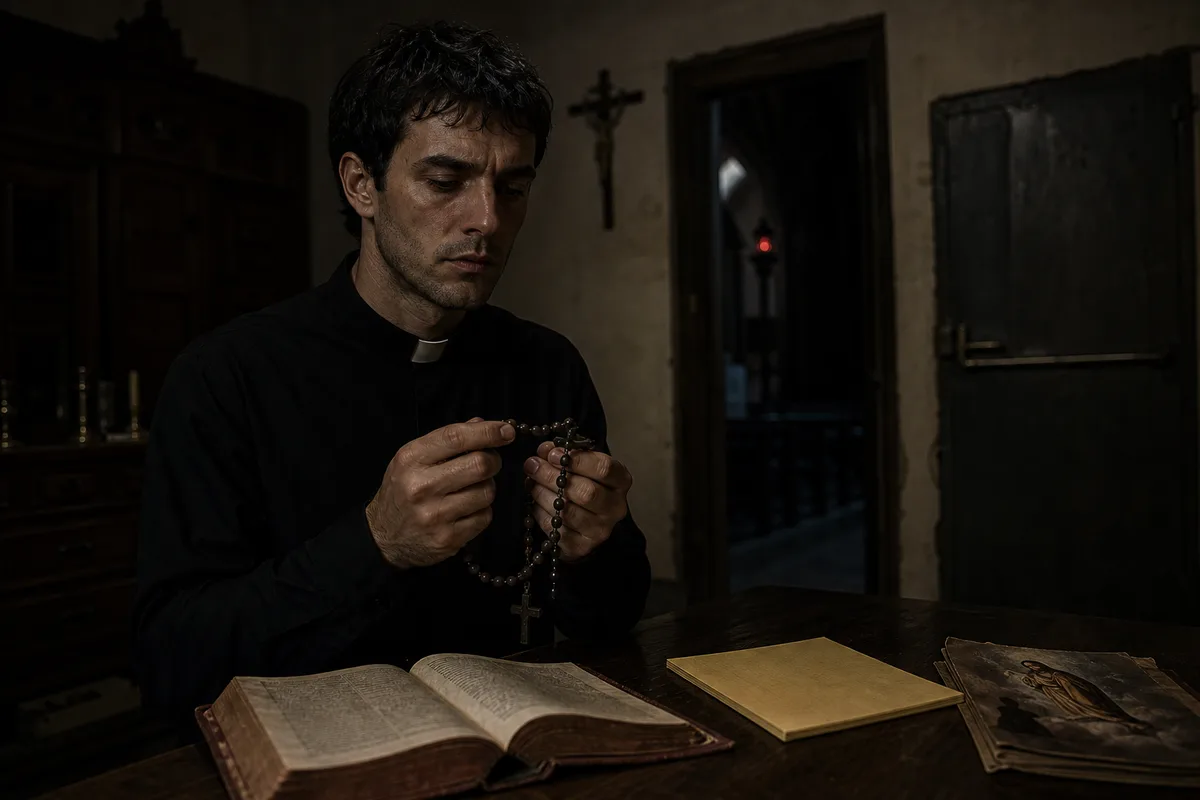
The Altar and Rosary Society met on the first Sunday of every month in the church basement, under a portrait of John Paul II that somebody had cut from a calendar and framed, and in March Señora Beatriz Olmos had asked the new padre whether he would speak to them in May. May was Mary's month. Father Kowalczyk had always done it, and Father Kowalczyk was in Arizona now for his lungs. She gave Tomás the pamphlet Father Kowalczyk used. It was folded in three and printed in two colors, and on the front the Virgin leaned out of a cloud and handed a string of beads to a kneeling friar in black and white.
"Just the story," Beatriz said. "The ladies like the story."
He had meant to tell them the story. He had only wanted to tell it correctly.
That was all it had been at the start: the habit Mundelein put in him, which was to go to the source before opening his mouth about it. The rectory had the old Catholic Encyclopedia on the bottom shelf of the front parlor, fifteen volumes in cracked red buckram that nobody had opened since the Council, and volume thirteen fell open at Rosary as if it had been waiting for him. Herbert Thurston, of the Society of Jesus. Nineteen twelve. The imprimatur of the Archbishop of New York on the flyleaf.
Thurston had gone looking for Saint Dominic and had not found him. Not in the saint's own lifetime, not in the lives written by the brothers who had known him, not in two hundred years of Dominican chronicle after that. What he had found instead was a friar named Alan de la Roche, who began preaching around 1470 that the Virgin had given the rosary to Dominic with her own hands, and who supported the claim with the testimony of learned authorities. The authorities did not exist. Alan, Thurston wrote, had been "full of delusions, and based his revelations on the imaginary testimony of writers that never existed."
Tomás read the sentence four times. Then he did what Thurston must have known a certain kind of reader would do, which was to decline to take a Jesuit's word for anything concerning the Dominicans. On Monday, his day off, he drove the forty miles to Mundelein and sat in the Feehan library until they put the lights out over the reading tables, with Quétif and Échard open in front of him: two Dominicans, writing about their own order, in the Latin of 1719. They said it too. The writers were invented. The Dominicans had known for nearly three hundred years and the Jesuits had printed it for nearly ninety, and in the basement of his church on the first Sunday of May, fourteen women who had said the rosary every day of their adult lives would sit under the Pope and wait for him to tell them about the Virgin in the cloud.
That was Sunday. Tonight was Tuesday, and he was in the sacristy after the evening Mass with the pamphlet on the vesting counter, and the red volume beside it, and a legal pad with nothing written on it but the date.
He could tell them. He had tried the sentence several ways, and every one of them ended with Beatriz Olmos asking why, if it wasn't true, the Church still said it was, and he did not have an answer that was also a thing a priest could say in a basement.
That was not what kept him in the sacristy with the lights on. He could write them a talk about the Hail Mary, which was scripture from its first line, and say nothing about Dominic at all, and nobody in the basement would notice. He had been trained to do exactly that. It was called pastoral prudence, and he had gotten an A in it.
What kept him was Marcos Rivas.
Eleven nights ago Rivas had knelt on the other side of the screen and told him the thing, and when he finished there had been a silence long enough that Rivas said "¿Padre?" into it, and Tomás had understood that the rite still had one more step and the step was his. A priest may not absolve without a penance. He had sat in the dark with the thing still hanging in the air between them and searched the whole of his training for a proportionate response and found that the training did not contain one, because the Church did not do proportion. It did the sacrament. It had given him, for this, the same tools it gave him for a boy who lied to his mother.
So he said the words, and then he said: a rosary. Every day, for a month.
He had seen Rivas twice since, in the last pew at the evening Mass, head down, the beads going through his fingers. Doing exactly as he had been told. Fifty Hail Marys a night on a string a liar had handed a saint who never held one.
Putant enim quod in multiloquio suo exaudiantur. Matthew six, seven. They had you learn it first year so you could explain why it didn't apply.
He had not gone to seminary because he believed. He had never said that to anyone who could do anything with it. He had gone because people told him things, and had told him things since he was a child on the stairs of a two-flat off Ashland, and the priesthood was the only institution he had ever found with a job description for that. Belief, he had assumed, would arrive the way competence arrived. It never had, exactly. It had simply never left, and for six years at Mundelein and two in the box he had taken the not-leaving as an answer.
Tonight it was leaving. He could feel it the way you feel a tooth that has started to move. Not because of Dominic. Dominic was a footnote; he had known seminarians who thought the Shroud was a painting and went on to be excellent priests. It was leaving because for the first time in his life he had taken something he had been handed and checked where it was fastened, and it was not fastened to anything, and the people who had handed it to him knew. They had known for ninety years. They had kept teaching it, and they had sent him into a confessional with it to give to a man like Rivas as though it weighed something.
If they had done it with this, he did not know what else they had done it with. And he could not unlearn how to check.
His own beads were in his hand. He did not remember taking them out of his pocket. They had been his grandmother's, black wood worn gray at the Our Fathers, and his thumb had found the crucifix and was going round and round on it, which was a thing his thumb did when he was not attending to it.
He put them down on the counter beside the pamphlet. He picked them up again.
One. Say one properly and listen. If anybody's there, you'll hear it.
He was on the third bead of the first decade when the alley door opened.
The sacristy had two doors: one into the sanctuary, and one into the alley behind, which was steel and had a bar across it after dark because the neighborhood was what it was. He had put the bar across himself at eight. He heard it lift. He heard the door swing, and the April night came in smelling of the panadería on Eighteenth Street and rain on warm tar, and a man stepped over the sill and closed the door behind him and set the bar back in its brackets.
He was perhaps fifty. He wore a gray suit that fit him and a raincoat over it, and his hair was white and cut short, and a pair of reading glasses hung on a black cord around his neck. He looked like a man from the Chancery. That was Tomás's first thought, and it was the thought he would come back to afterward, for years, because it was exactly right: a man from the Chancery, come to see about an item on a list.
"The church is closed," Tomás said. "If you need a priest, the rectory is..."
"Serrano, Tomás." The man had a small black notebook open in his left hand and was reading from it, and he did not look up. "Nineteen seventy-three. Mundelein. Ordained at Holy Name in May of ninety-nine. Latin, excellent. Greek, adequate. Sent here last year for the Spanish." He turned a page. "The Spanish is not Mexican."
He said the last of it in Spanish, and his was not Mexican either. It was Spain's Spanish, the soft lisping c and the vosotros, the Spanish Tomás's mother had put in him and the whole of Pilsen had spent a year gently laughing at. Nobody in this city spoke it to him but her.
"Who are you?"
"Your faculties are in order. You hear confessions Thursday and Saturday. You say the evening Mass on weekdays and you are the last one out of this building every night." Another page. "You have not slept well in eleven days."
It was true, and he had told no one, because there was no one to tell. He had lain in the rectory bed every night since Rivas looking at the ceiling, and got up at five, and gone through the day, and it had not occurred to him that anybody in the world had noticed. A man in a gray suit had noticed, and written it down.
"I'd like you to leave," Tomás said.
The man closed the notebook on one finger to keep his place and looked at him for the first time. His eyes were an ordinary brown. He looked at Tomás the way the Chancery auditor had looked at the parish books in January, not unkindly and not kindly, measuring the thing in front of him against a figure he already had.
On the back of the sanctuary door hung the long mirror the priests vested in front of. Tomás could see himself in it, in his black shirt and collar with the beads in his hand, and the vestment press, and the crucifix on the wall. Where the man stood, the mirror showed a fault in the glass: a gray unsteadiness the height of a man, as if the silver behind it had lifted there and let the dark through.
Tomás did not believe in that. He had not believed in it at eight o'clock and he did not believe in it now, and he found that his body did not need his permission to know what it was looking at. His hand had closed on the beads hard enough that the crucifix was cutting into the heel of his palm.
"En el nombre del Padre," he said, and it came out as a whisper, and he heard it come out as a whisper and was ashamed.
The man watched him make the sign with the attention of a clerk checking a signature against the one on file.
Tomás went for the sanctuary door.
He was two steps from it. The sanctuary lamp was on the far side, red on the marble, and his own shadow ran ahead of him across the floor toward it the way a shadow does with the light behind you. Then his shadow stopped, and he did not.
It took him at the ankles. There was nothing there. He looked down and there was nothing there, only the tile and the long dark of his own shadow lying across it, and his feet would not come up off the floor. Then it was at his knees and his wrists, and there was still nothing there, and it was cold in a way nothing in April was cold, and it put him down on his knees on the sacristy floor facing the man, as neatly as a server kneels at the Sanctus.
The beads were still in his hand.
The man put the notebook in his inside pocket. He took off his raincoat and folded it over the back of the vesting chair, and took the glasses off their cord and put them in their case. He did not hurry, and he did not do anything he did not need to do.
"Wait," Tomás said. "Please. Whatever you think I... I haven't..."
The man crouched in front of him, the way you crouch to talk to a child, and did not answer, and Tomás understood then what would be the worst of it, not that night but for the next twenty-five years. Nothing he said was going to be heard as a word. He could argue. He was good at arguing. He could have argued this man to a standstill on any subject in the world, and it would have made precisely as much difference as the Hail Marys going through Marcos Rivas's fingers at the back of the church.
He was not being asked.
Ask me. Ask me anything. Let me say no to something.
"Why me?"
The man took his chin in one hand, not roughly, and turned his head to the side and toward the light, the way a doctor does.
It hurt the way a thing hurts when it is done competently by someone with no interest in you. Then it stopped hurting, and that was worse, because it meant the part of him that kept the accounts had stopped keeping them. He was aware of the man's other hand spread flat between his shoulder blades, holding him up. He was aware of his own pulse slowing in his ears, a long way off, like a Mass being said in another building.
His thumb was moving on the beads. He had not told it to. It had gone back to where it was when the door opened and was going on, bead by bead, and his mouth was going on with it without sound, because the prayer was older in him than the checking and did not yet know what he had found out on Monday.
Santa María, Madre de Dios, ruega por nosotros pecadores, ahora y en la hora de nuestra...
He knew the next word. He was aware, with the last of the part of him that noticed things, that tonight of all nights the sentence had become literally true, that this was the one night of his life it would ever be accurate, and he did not get to the end of it.
There was nothing for a while, and he was not there for it.
Then there was a wrist against his mouth, and something running out of it that was not warm, and he was drinking. He had not decided to. There was nobody there to decide. Something older than the prayer had got up in the place where he used to be and taken hold of the wrist with both his hands and was pulling at it like an infant, and when the man took it away the thing made a sound that Tomás would hear again, many times, and never once agree to.
More.
The man stood. He wiped his wrist with a white handkerchief and folded the handkerchief away, and put his glasses on, and took out the notebook and uncapped a pen and wrote a single line. Tomás, on the floor, who could see and hear everything now with a clearness he had no name for yet, heard the nib go across the paper and could not read it upside down.
The beads had gone out of his hand at some point. They lay on the tile by the vestment press. The man stooped and picked them up and looked at them, the black wood worn gray, and hung them on the hook inside the press where the stoles hung, neatly, the way a man puts a thing back where it is kept.
"Tomorrow you will say the evening Mass," he said, in Spain's Spanish. "You will be hungry. Do not feed on anyone who comes to it."
He put on his raincoat. He lifted the bar, and went out into the alley, and did not put the bar back, because there was no longer anything in the sacristy the bar was for.
Tomás lay on the floor until he could move his mouth.
"Muerte," he said.
It was the first thing he had been allowed to finish all night, and the hour it asked for had already gone by.
Leave a Comment
The Sacristy
There's no live comment thread here - your comment goes straight to the author's inbox.
By sending a comment, you agree to allow the author to share your comment publicly. Anything included in your submission — including your email address — may be made public. You have been warned.
Got it — thank you.