It was a quarter to one in the morning, and Tomás was in the sacristy of St. Dismas with the celebret register open on the vesting counter, looking for Rome.
Somebody at the shelter had heard it from somebody's cousin, the way everything in Pilsen was heard: priests from Rome, two of them or three, asking questions on the West Side. Not at the parishes. At the hospitals, and at night, the place to ask if the question was who took the night calls. Tomás had spent a week not believing it. Tonight he had believed it enough to go through his own books.
A priest from outside the diocese who wanted to say Mass at another man's altar signed the register and showed his celebret, the letter from his own bishop that said he was in good standing and could be trusted with the chalice. St. Dismas did not get many. The last name in the register was a Franciscan from Joliet, in Lent of 2022, who had stayed for the fish fry. Before him there was nobody for three years. Nobody from Rome had ever asked to say Mass at St. Dismas, which was either reassuring or exactly what a man from Rome would arrange.
The rectory phone rang while he was closing the register. Agnes Kubiak, from the Archdiocese records office, calling from her own kitchen with the television on behind her. She was one of the two who let him into the closed-parish files after five without a requisition, and she was the one he had asked, a week ago, to keep an eye on anything with Rome on it.
"Nothing, Father," she said. "No letters, no faculties requested, no celebret on file for anybody passing through. If there's a priest from Rome in this city, nobody told the Chancery." He heard her turn a page. "One thing, though. Hospital Ministry put a referral through on Friday for one of yours. Beatrix, from St. Dismas? Baptist Charity, on Ogden. She's been asking for her pastor since Thursday night, and the note says nobody's been out to her yet."
"Then it's me," Tomás said, and took his coat off the hook.
Baptist Charity sat behind a parking structure and a row of bail bondsmen, eight stories of yellow brick with the year 1923 cut over the door and a verse from Matthew under it about the least of these. There was no crucifix in the lobby, only a plain brass cross with nobody on it, and a painting of Jesus with a lamb that somebody had hung slightly too high. The night guard was a deacon at a storefront church on Madison and called him Reverend, which Tomás had long since stopped correcting, and he turned the chaplaincy sign-in book around on the desk without being asked.
"Who you here for tonight?"
"One of mine. Beatrix, on six."
The guard checked a printout taped to the desk. "Six-fourteen. Came in Thursday."
The book was a green ledger with a pen on a chain. Tomás uncapped the pen, and found the next empty line, and the line above it was not empty.
Friday. 2:47 a.m. Floor six. No room given. Pastoral visit. The signature was a single long stroke with a loop in it, made by a hand that had signed a great many things and expected to be recognized rather than read. In the box for parish or affiliation, in small square capitals, somebody had written ROMA.
He looked at it for a while.
"This one," he said. "Do you remember him?"
The guard leaned over and looked and frowned. "Thursday's not my night." He scratched his jaw. "Same floor as your lady, though."
Tomás signed his name under it, in the hand Mundelein had given him, and wrote St. Dismas in the box, and did not write anything else.
He took the stairs. He always took the stairs at Baptist Charity. The elevators were lined in brushed steel.
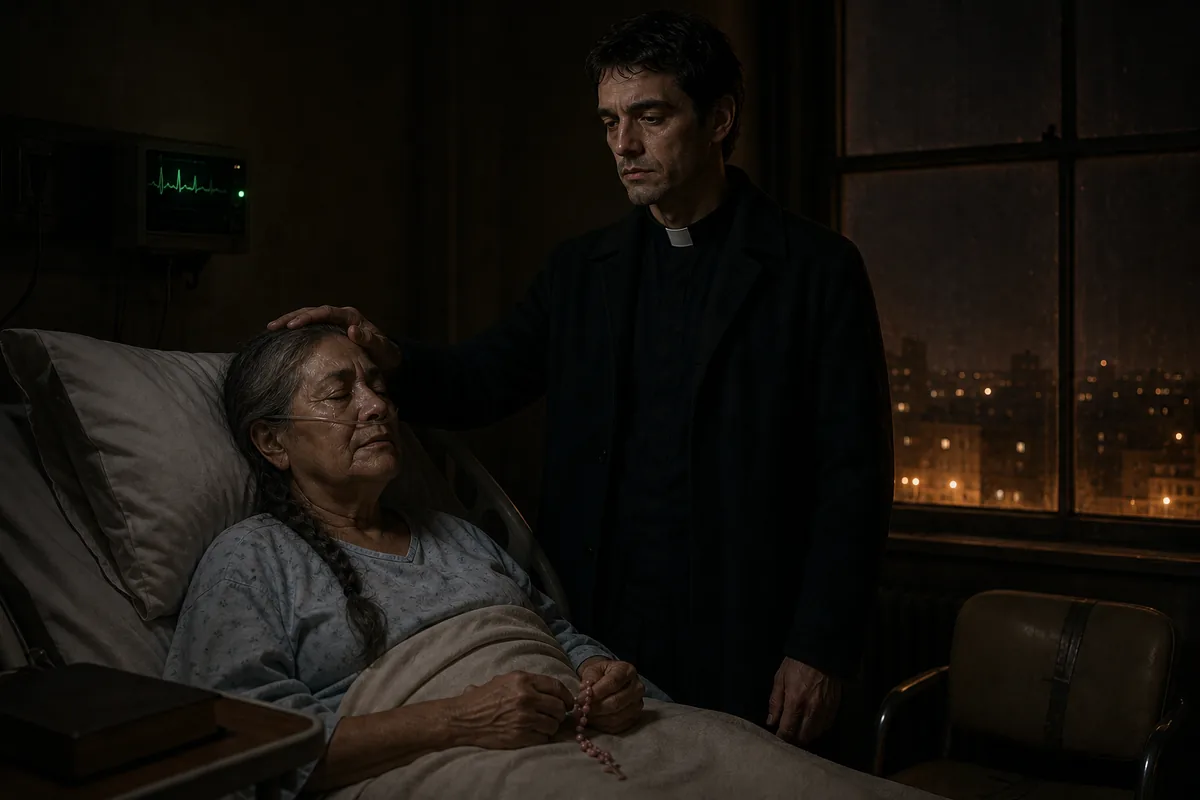
Room 614 had the bed by the window. The blinds were up and the West Side lay out under them in orange sodium light, and Beatrix was sitting up against three pillows with an oxygen line under her nose and her rosary in both hands on the blanket, the plastic kind the parish gave away at Lent, pink, worn white at the Our Fathers. She was seventy-eight. She had sat in the fourth pew at the seven o'clock every weekday since before he came to St. Dismas, and she told him things through the screen on Saturdays that a girl might have told him in 1950, and he kept every one of them.
She saw him in the door and her whole face went up.
"¡Padre!"
"Buenas noches, Beatrix."
She patted the blanket beside her. "They told me you were sleeping."
"They tell everyone that." He took the chair by the bed. It was the chair every family member in the building had sat in at some point, vinyl, the seat split and taped. "What are you doing in a Baptist hospital at two in the morning?"
"My heart." She waved the rosary at the monitor as if it belonged to somebody else. "Junior brought me. This is the close one." Then, lower, in her Saturday voice: "Padre, I have to tell you something, and you can't laugh."
"I don't laugh at two in the morning."
"Since I was a little girl," she said. "In Zacatecas. Seven, eight years old. I'd be in the bed and there'd be a scratching. Down low." She drew her fingernails down the blanket over her shin, slowly, and he heard it. "Like a dog at the door wanting in. My abuela said that was the devil come for what's his. She said we're all born his. El pecado de Adán. It's in the blood, and he has the papers on us, and that's why we have to be baptized." She looked at the rosary. "I was baptized. First Communion. Confirmation from the bishop. Seventy years of Mass, Padre. It never stopped. Quiet for a while, sometimes. Never stopped."
"And lately?"
"Lately I can't sleep." Her voice did not change, and he respected that very much. "Under the bed. In the walls. This summer it was at my feet. Pulling, like it was tired of waiting." She looked at him to see if he would laugh. He did not. "Thursday night my grandson brought me in through those doors downstairs, and it stopped. Right at the door. Four nights. Nothing."
Thursday night.
Tomás looked at the corners of the room.
He did it without seeming to. He had a way of looking now that he had not had at twenty-seven, a way that went down past what the light was doing into what the dark was holding, and he let it go into every corner of 614, under the bed and behind the curtain and into the narrow gap between the wardrobe and the wall. There was dust. There was a dropped pill under the radiator. There was nothing else. The room was as empty as a room could be, in every sense he had a way of measuring.
"Padre." She had seen him look. "Is it gone? Or is it waiting outside?"
"Why do you think it stopped here?"
She frowned. She had wanted an answer and he had given her a question, and she had been getting questions from him on Saturdays for years and had never once got used to it.
"That's what I don't understand," she said. "It's not even ours. It's Baptist. There's no Mass here. There's no Blessed Sacrament. There's a cross downstairs with nobody on it." She lowered her voice again, as if the Baptists might hear. "Is it even holy? Is God even here, in a place like this?"
He thought about that seriously, because she deserved it.
The Code of Canon Law had a title for sacred places, and Baptist Charity was not one of them. No bishop had walked these halls with the chrism. There was a dedication plaque by the lobby elevators with the names of eleven deacons on it, and in the book he had been ordained to keep, that and a dollar would get you on the bus. He had believed that once. He had believed it the way a man believes the instructions on a fire extinguisher, without examination, because surely somebody had checked.
"The first place God ever called holy," Tomás said, "was a patch of desert with a bush in it. Exodus, chapter three. There was no bishop. Nobody had consecrated anything. Nobody's name was on the deed. Moses took his shoes off because of who was standing there with him, not because of whose sign was over the door." He let her have that. "It's a Baptist hospital, Beatrix. It's still holy ground. It's as holy as any I've stood on."
That last part was true, and it cost him something to say it, and she could not know what. He had stood on consecrated ground in Pilsen and at St. Dismas and at Holy Name under the Cardinal's own eye, every night for twenty-five years, and none of it had ever once refused him. He had stopped expecting it to. He had not, he found, stopped noticing.
"Then why did it come for me in the first place?" She was gripping the rosary now. "If I'm baptized. If I go to confession. Abuela said it's the sin we're born in, and it doesn't come out, and the devil has a claim on it. When they send me home he'll be waiting to collect."
There it was.
Rome had an answer for her, and he knew it by heart, with the paragraph numbers. Contracted and not committed. A state and not an act. Remitted at baptism, which hers had been, in a stone church in Zacatecas seventy-eight years ago with real water. Trent had put an anathema on anyone who said otherwise. He had sat the examination on it at Mundelein and got the second-highest mark in his year. And Rome's answer had been sitting in her for seventy years, and the scratching had gone on right through it, because nobody had ever told her plainly what the answer meant.
And there was the other canon, the one he had spent twenty-five years trying to break and could not. It said a curse could be handed down in the blood. It said a man could be damned for a thing done before he was born, by somebody he never met, and it said so in a voice he had tested against everything he knew and found that it held. He was the proof of it. He was sitting in her taped vinyl chair.
He found he did not care what either of them said about Beatrix.
He gave her Rome's answer anyway, because it was the one he had been ordained to give, and it was the one she had come to the fourth pew for seventy years to hear. Washed. Remitted. He gave it well; he had always given it well. He watched it go into her and land on nothing, as it always had.
"That's what the sisters said," Beatrix said, and looked at the rosary. Then: "Bendígame, Padre. Do it now, before I think about it."
His stole was in the lining of his coat, where it lived. It came out twice a week in a locked sanctuary at midnight and at no other hour, and he did not reach for it. He stood, and put his right hand on her head, on gray hair her granddaughter had braided for the hospital, and he felt the warmth of her come up into his palm like news from another country.
He gave it to her in the Spanish his mother had put in him, the Spanish of Cádiz that Pilsen had laughed at for a year and St. Dismas had long since stopped hearing. "La bendición de Dios todopoderoso, Padre, Hijo, y Espíritu Santo..." She crossed herself with him; she had been crossing herself to those words for seventy years. "...descienda sobre ti, y permanezca para siempre."
She was looking up at him. She had found his eyes and was holding them, the way the frightened do when they are told something they want to believe and are checking the face for the lie.
He should have stopped there.
"Nunca fuiste suya," Tomás said. "Never his. Listen to me. What's the first thing God ever told a man and a woman to do?"
She blinked up at him. Then, because she had been a catechism girl in a white veil: "Creced y multiplicaos."
"And did you?"
"Seven." Her thumb stopped on a bead. "Five living. Eleven grandchildren. Two great."
"Then why would He damn those children for being exactly what He asked you for? He wouldn't. He didn't. 'The soul that sinneth, it shall die. The son shall not bear the iniquity of the father.' Ezekiel, eighteen. Twenty. Whatever Adam owed, he owed. It was never on your account. Nobody is born owing for being born. Nobody."
That was where the sermon he had been ordained to preach would have ended, and further than it should have gone. It did not end. Under the words, the thing that lived in him had lifted its head at the sound of his own conviction, and it leaned its weight into his voice and pushed, and the words kept coming, and they were no longer the ones Mundelein had given him.
"Read what He actually said in the garden. Read it slowly. He cursed the serpent. He cursed the ground, for Adam's sake. He never once cursed Adam, and He never cursed Eve. There is exactly one man in the whole of Genesis that God curses with His own mouth, and it isn't the father. It's the son. 'Now art thou cursed from the earth.' Chapter four. The first murderer. And the Lord set a mark on him so that nobody could kill him and end it, and sent him out east of Eden into the dark, and the curse went with him. In the blood. And it goes only where he puts it. He made the Second, and the Second made the Third, and they built a city before the Flood, and the curse went into every one of them and every one they made after, childe from sire, down and down and down, and the Flood did not wash it, and the Church has never once been able to touch it. And not one drop of it ever went to you, Beatrix. Not to you. Not to your seven. Your abuela was right that it's in the blood. It's just not in yours."
He heard himself say childe.
In a hospital room, at two in the morning, to a woman from the fourth pew, with his hand on her head. He heard it the way a man hears a glass break in another room, a moment after it has already broken, and he stopped.
The room was very quiet. The monitor kept count.
Beatrix looked up at him for a long time. He waited for her to ask him whose blood, then, and he did not have an answer that was also a thing a priest could say in a hospital.
She did not ask.
Her face changed instead.
He knew that change. He had seen it perhaps nine thousand times through a screen, and on her own face on a great many Saturdays. It was the face of a person setting down something heavy, the shoulders letting go, the jaw letting go, the eyes filling. It was the face of absolution, and it was real. Rome had been trying for seventy years and he had done it in one night, and he would not have taken it back.
"Then it was never me," she said.
"No."
"Never me." Tears ran down into the oxygen line. "Ay, Dios. Seventy years."
And he had paid for it with everything else he had said. The Mark. The Second and the Third. A city before the Flood. Sire and childe. Things he had sat through twenty-five years of being drilled in by men who would have opened his throat for saying them aloud to a mortal, and he had said them to Beatrix, who told the Guadalupanas everything, and who would tell the next priest who sat in this chair everything, and who had no idea that any of it was anything but a very good homily.
And under that, quieter, the thing was saying something else. You have kept her Saturdays for years. She is warm under your hand, and she has never in her life been less afraid of anything, and she would never know.
She had not confessed. Not tonight. He fed on the ones who confessed, in the hour they confessed, and only on those.
He took his hand off her head.
"Amén," said Beatrix, with her eyes shut. "Ay, Dios. Amén."
He said it with her, one word behind.
When she opened her eyes she looked at him as she did through the screen at the end of a long Saturday, as if he had done something for her, and she reached up and caught his hand before he could put it in his pocket.
"Ay, Padre, you're so cold."
He did not take the hand back. "It's the hours."
"You'll come back? Before they send me home?"
"Thursday."
"Thursday." She let him go. "It's quiet," she said, mostly to herself, and lay back on the three pillows with the rosary on her chest, and was asleep before he reached the door.
He took the stairs.
On the landing between five and four he stopped with his hand an inch off the rail.
The line above his own in the green ledger. A quarter to three on Friday morning, the sixth floor, and Rome. The same night Junior had brought her in through the doors downstairs and the scratching had stopped at the threshold.
He did not know what had scratched at Beatrix for seventy years. He had looked into every corner of her room and found it empty, and he did not know whether that meant there had never been anything there or whether it meant something had left. But he had grown up off Ashland and worked in Pilsen, and he knew what every dog on Eighteenth Street knew: the things that scratch at doors go quiet when something larger comes into the yard.
Something larger had come into the yard on Thursday night, and signed the book. Tonight something larger had come up the stairs and sat in her chair. And on Thursday, when he came back as he had promised, she would be sitting up against her three pillows waiting to tell him what she had worked out about the first murderer and his city before the Flood, and whoever had signed for Rome would know which floor to come back to.
He had told her she was standing on holy ground. He had not told her who else was standing on it.
Leave a Comment
The Ministering
There's no live comment thread here - your comment goes straight to the author's inbox.
By sending a comment, you agree to allow the author to share your comment publicly. Anything included in your submission — including your email address — may be made public. You have been warned.
Got it — thank you.